The One-Liner: Answering 'What Do You Do?' in a Sentence That Books Consults
The standard contractor introduction is true, professional, and books nothing. Build the three-part sentence that replaces it — their problem, your move, their result — then run it everywhere your company speaks.
7 min read · July 6, 2026 · Florida Construction Media

Ask a Florida contractor what he does and you'll get the company résumé read aloud: "We're a full-service design-build firm serving Sarasota and Manatee counties since 2009." Licensed, insured, family-owned. Every word true, and not one of them a reason to keep talking.
The sentence fails because it's about the wrong party. The license, the tenure, the service area — all yours. The woman who asked, at the fish fry or in the pickup line, doesn't have a design-build problem. She has a kitchen she's embarrassed to host Thanksgiving in and a suspicion that remodels wreck households. Your introduction gave her nowhere to put either one, so she says "oh, nice," and the conversation drifts to red tide.
The fix is one sentence in three parts, about an hour of honest work. Done right, it runs everywhere the company speaks — website, Google listing, video, every crew member who wears the logo into a supply house.
Nobody hires a résumé
The standard introduction is a compliance document. It certifies you're legitimate, established, and broadly capable — things a buyer confirms eventually, none of them what she's filtering for in the first ten seconds. Her first-contact check is simpler: does this person deal with my situation. Miss it and the credentials never get their turn.
People don't file companies in memory; they file answers to problems. "Design-build, since 2009" gives the listener no slot to put you in, so you land in the drawer marked "contractor, seemed nice." A sentence that names a problem she has — or her sister has — gives her a slot. Slots get recalled at dinner parties. Drawers don't.
Run the interchangeability test: cover the logo and ask whether any of forty firms in the county could say your answer word for word. If they could, it isn't an introduction. It's a category label.
One sentence, load-bearing · Illustration: Florida Construction Media
Their problem, your move, their result
The structure is borrowed from StoryBrand, which calls it a one-liner. The trades translation is short: stop being the hero of your own sentence. The homeowner is the hero; you're the one with the plan — the same shift that should run through your whole website, compressed into one breath. Three parts, in order:
The problem your best client feels. The best client is the one you'd take ten more of tomorrow; use the words she'd use complaining to a friend: dust, strangers in the house, a backyard nobody sits in. "Scope creep" is your word; nobody complains to a friend about scope creep.
What you do about it. The operational move, not the adjectives. "Quality craftsmanship" is claimed by every outfit in the state, including the ones that ghost after the deposit. Mechanisms are harder to fake: one crew on one job, open-book pricing, a schedule written into the contract, a photo record of every stage.
The result they get. What life looks like when you're done. Moving in on the date that was promised. An insurance file that answers its own questions. Dinner outside in August.
One rule governs all three: the sentence must be true. If you bill time-and-materials, you don't say fixed price. The constraint is the point — a one-liner is a promise you'll be held to, and a competitor who doesn't run your operation can't steal a sentence that describes it.
Six worked examples
Adapt these; don't adopt them. Each only works for a company whose middle clause is a fact.
Custom builder. "Most families building on the Gulf Coast are braced for a budget that doubles and a schedule that slips a year. We build on open-book pricing with the schedule written into the contract, so our clients watch a house go up instead of watching for the next surprise."
Kitchen-and-bath remodeler. "A kitchen remodel usually means two months of dust, strangers, and takeout. We put one dedicated crew on one job until it's finished, so homeowners get their kitchen back on the date we wrote down — not the third revision of it."
Luxury painter. "Most repaints on this coast look perfect at the walkthrough and start chalking by the third summer. We do the prep the sun will test, not the prep the walkthrough will, so the finish is still tight while the neighbors are collecting quotes again."
Outdoor living builder. "Most Florida lanais get admired from inside the air conditioning. We build shade, breeze, and outdoor kitchens that work in August, so families actually eat out there instead of looking at the furniture through the slider."
Roofer. "Nobody thinks about a roof until there's a stain on the ceiling or a letter from the insurance carrier. We replace roofs with a photo record of every stage, so when the carrier has questions, our homeowners have a folder instead of a guess."
Window-and-door contractor. "Every June, homeowners stare at their windows and try to remember what the sticker said. We install impact windows rated for this coast and stand behind the installation, not just the glass, so the house is ready before the first cone shows up on the news."
None of these contain a founding year, "full-service," or a list of counties. Each names a person, a pain, a mechanism, an outcome — and could only be said by a company that works that way.
Where the sentence goes to work
Website hero. The first line above the fold, replacing "Welcome to" and the unexplained drone shot. A visitor gives a homepage a few seconds; the one-liner is the only text you can count on being read.
Google Business Profile. The first line of the business description, and the spine of the owner-intro clip on the listing. When a homeowner compares three profiles side by side, at least two will open with the résumé answer. Yours shouldn't.
On camera. We've argued that owners shouldn't script their videos — the exception is the first sentence, and this is it. Problem first, name second: "Most families building out here are braced for a budget that doubles. I'm ______ with ______, and that's the thing we got rid of."
The supply house. When the counter guy asks your foreman who he's with, "the one-crew-one-job remodelers" does more marketing than the wrapped truck. Give the crew the short version and let them paraphrase — the spine survives it. Past clients work the same: people repeat the words you hand them, and improvise "they were nice" when you don't.
The stranger test
The test doesn't happen in a conference room. Say the sentence to someone who owes you nothing — school pickup, a wedding reception — and watch what comes back. A follow-up question means it works: "what does open-book mean," "how do you hold a date like that." A nod and a "that's great" means it doesn't — polite, and final.
Three ways to fail it:
Jargon. "Design-build," "turnkey," "value-engineered" — contract language, not kitchen-table language. If your client wouldn't use the word to complain to a friend, it doesn't belong in the sentence.
Cleverness. "We don't build homes, we build dreams" is a koozie, not an answer. Nobody asks a follow-up question of a pun. If it sounds like it was written for a billboard, start over.
The menu. "Kitchens, baths, additions, whole-home remodels, flooring, and outdoor spaces" hands the sorting job to the listener, and the listener declines it. Six services in one breath are remembered as zero.
Spec box: the one-liner worksheet.
- Their problem: "Most ______ (your best client) put up with ______ (their complaint, in their words)."
- Your move: "We ______ (the thing you do differently — a mechanism, not an adjective)."
- Their result: "...so they ______ (their life when the job's done)." The test: say all three lines to one stranger this week. A follow-up question means keep it. A polite nod means rewrite line one.
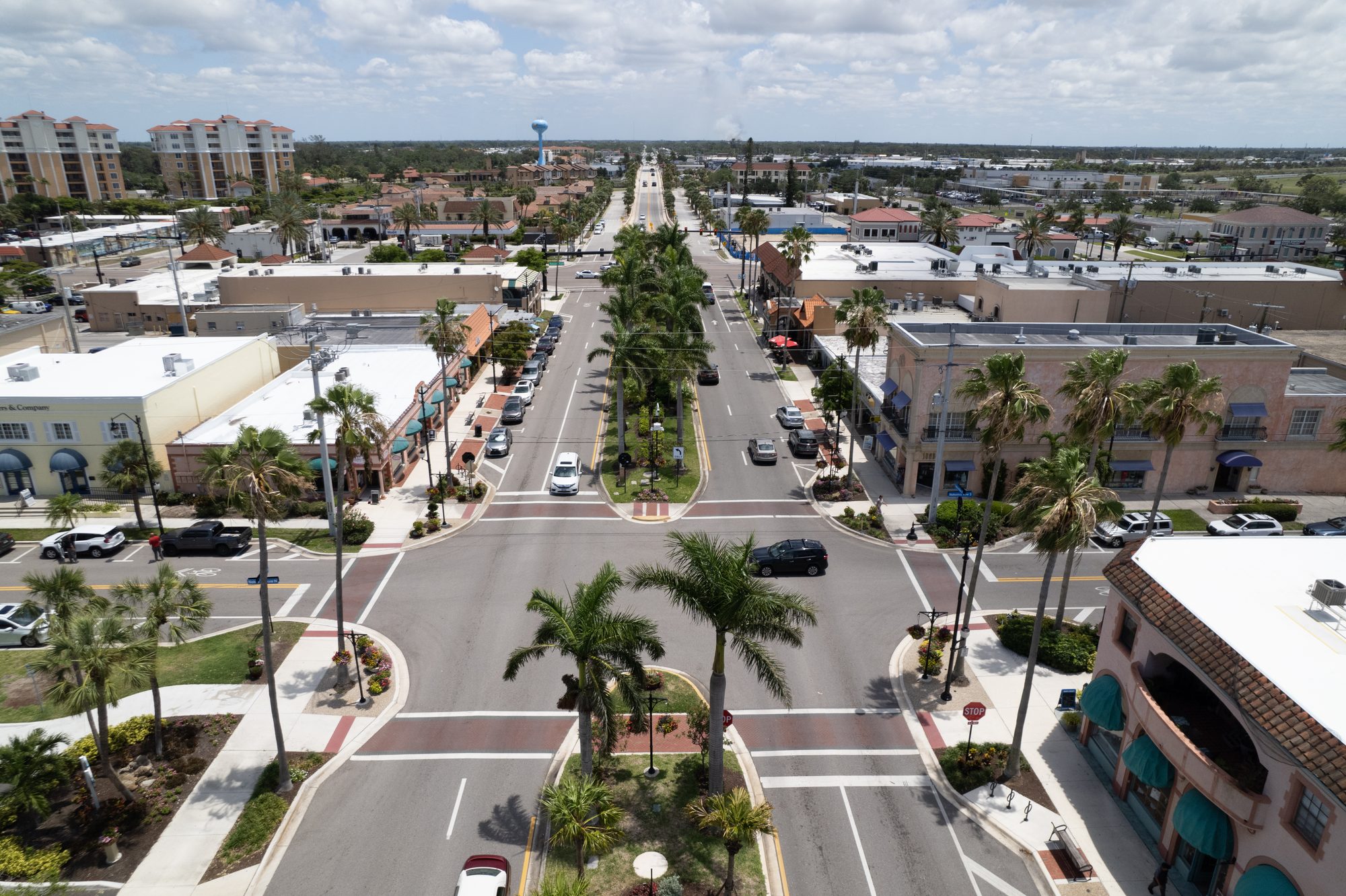
Every storefront on this street answers the question in one line · Venice · Photo: Stellar Media Collective
Questions builders actually ask
Do I need a different one-liner for every service we sell? No. One business, one sentence, aimed at the client you want more of. The remodeler who also takes handyman work leads with remodels; the handyman calls still come. Flex the wording for the room, but keep one spine. Two divisions that run as genuinely separate businesses earn separate sentences.
Isn't this just a tagline? A tagline is something you print; a one-liner is something you say. "Building Excellence Since 2009" decorates a truck door and answers nothing — no human being could respond to it. The one-liner answers a question people ask you every week, and it's built to provoke the next one.
If I name one kind of client, don't I lose everybody else? The math runs the other way. A sentence aimed at everyone is remembered by no one; one aimed at your best client gets repeated by everyone who's ever met one. The adjacent work still calls — the couple who hears your kitchen sentence doesn't rule you out for a bathroom. They file you as the outfit that finishes on the date it wrote down.
Published July 6, 2026. Disclosure: this publication is owned by Stellar Media Collective, a Sarasota studio that builds messaging and video systems for premium trades — one-liners included. The worksheet requires no vendor: a legal pad, an honest hour, and one stranger.