Drone & FPV on Active Job Sites in Florida: Part 107, Insurance, and What It's Worth
Aerial footage is either a licensed operation with paper behind it or an uninsured aircraft over your crew — and the difference costs a few hundred dollars and one conversation. What Part 107 requires, what the COI should say, and where drone work earns its line item.
8 min read · July 6, 2026 · Florida Construction Media
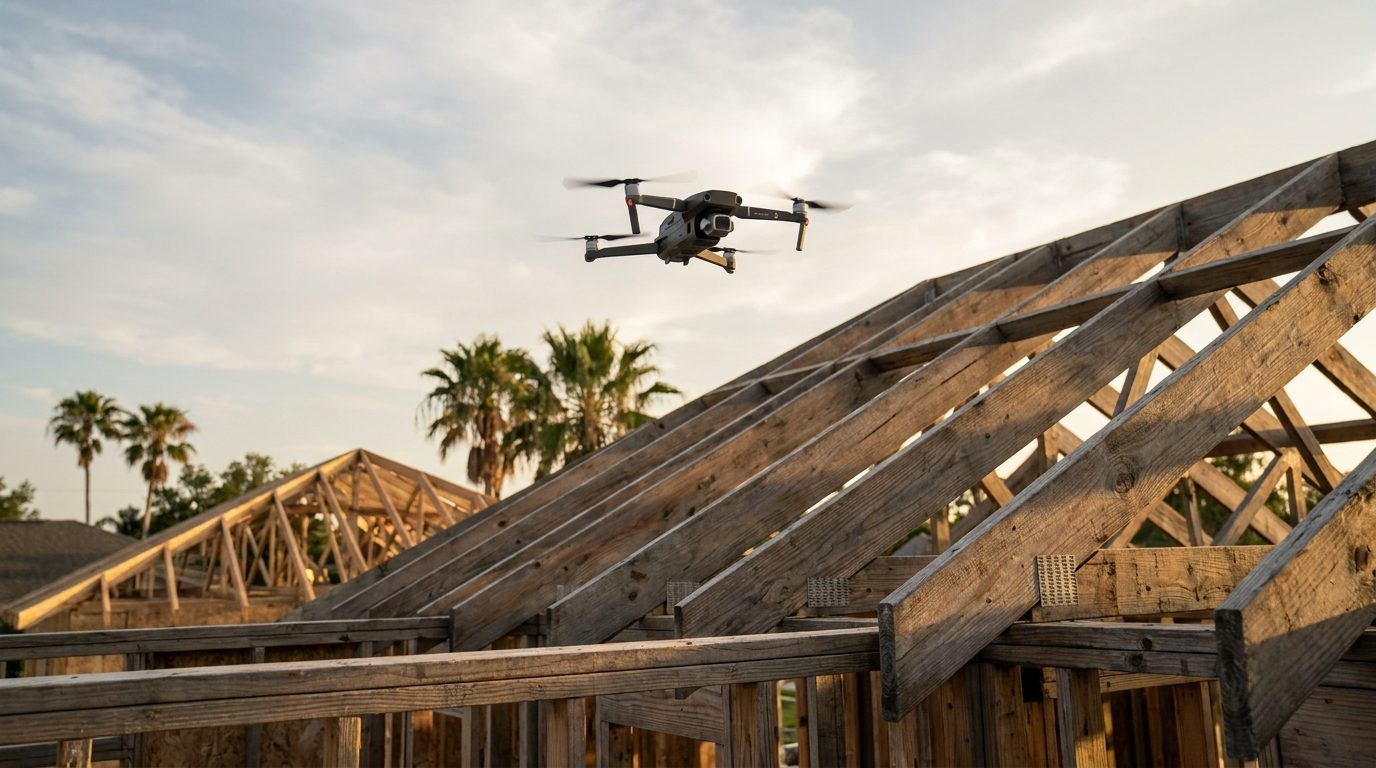
There are two ways drone footage shows up in a builder's marketing. The first way: somebody's buddy with a quadcopter launches over your active site — framing crew on the second floor, concrete truck backing in — and gets the shot. The second way: a certificated pilot checks the airspace, plans the path so the aircraft is never over your people, carries aviation liability insurance with your company named on the certificate, and charges a few hundred dollars more for the same afternoon.
The footage can look identical. The exposure can't. If the first one comes down on a worker or a windshield, the trail leads to the person who hired it.
If you check subs' licenses and COIs before their boots hit your slab, you already know how to think about this. A drone operator is a sub who works overhead. Vet accordingly.
Who can legally fly for your business
The rule is simpler than most people expect: any drone flight that serves a business — marketing, progress documentation, a roof survey, lot photos — is commercial work, and commercial work requires the pilot to hold an FAA Part 107 remote pilot certificate. Not the company. The person on the sticks.
The recreational rules that let a hobbyist fly in the park do not cover work done for a business, which is where the "my nephew has a drone" plan dies. The nephew flying for fun on Saturday is fine; shooting your spec house for the website is a commercial operation that requires the certificate, whether or not money changed hands. The test is the purpose of the flight, not the invoice.
Your own payroll is included: a super flying the company drone to document a pour is a commercial operation and needs the certificate. He can get one; see the questions at the end.
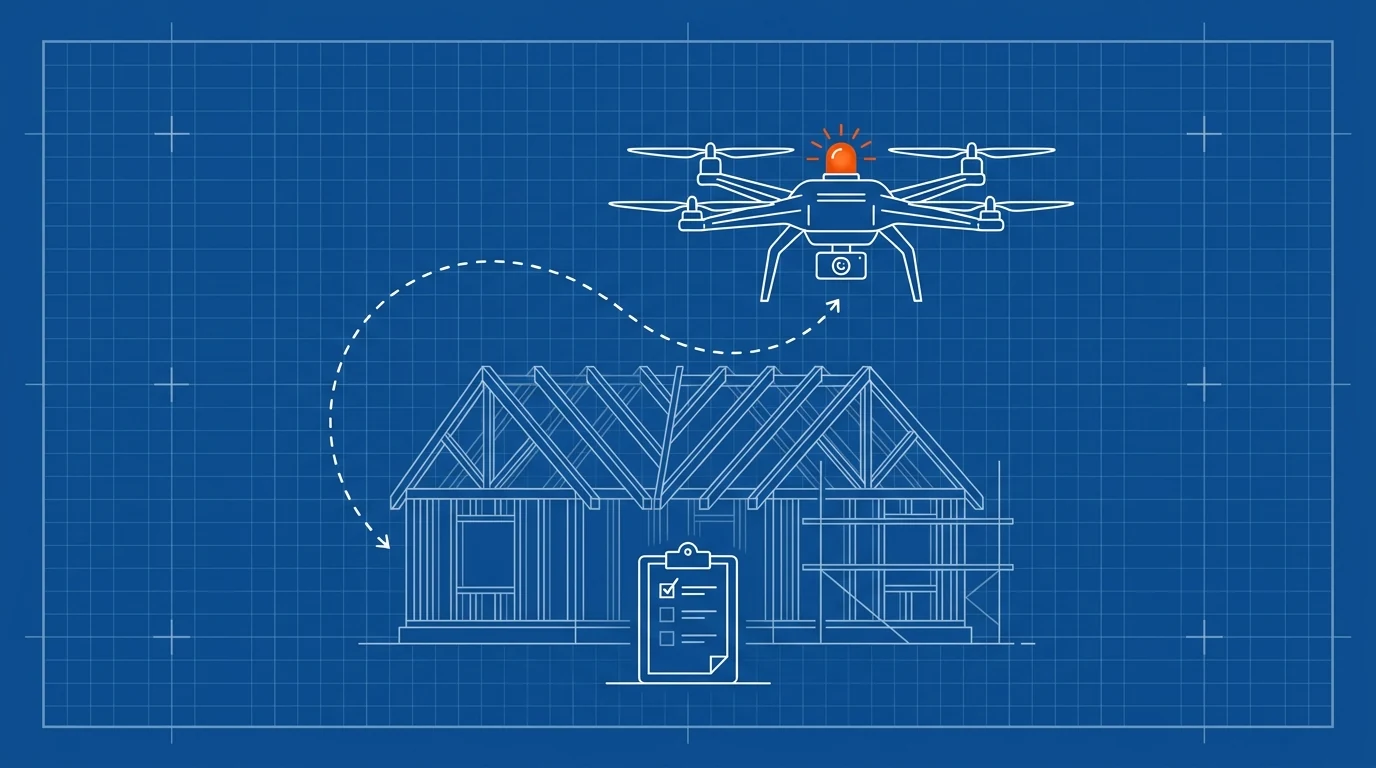
Licensed, insured, and planned — then fly · Illustration: Florida Construction Media
What Part 107 looks like on an active site
Hiring certificated is half of it. The other half is what a competent operator does differently on a live site.
Line of sight. The pilot generally has to keep the aircraft in unaided view. No flying from the truck around the blind side of the building.
Altitude. The general ceiling is 400 feet above the ground, with an allowance to go higher within 400 feet of a structure. Marketing shots of residential work live far below the ceiling; anyone pitching high-altitude footage of a two-story build is selling drama, not coverage.
Flights over people. The one that matters most on an active site. The rules restrict flying over people and over moving vehicles, under operational categories that depend on the specific aircraft. Practical translation: a professional plans shots so the drone isn't over your crew — approaches over the street, orbits offset from the building while trades are on it — and schedules aerials for quiet windows: early morning, lunch, after crews leave, which is the best light anyway. An operator who launches over a working deck without a conversation is telling you how the rest of the operation runs.
Airspace. A large share of coastal Florida sits under controlled airspace tied to an airport, and flying there requires authorization first. LAANC makes this fast — often minutes on an app — but it must happen, per location, before takeoff. Ask how the airspace looks at your address and listen for a specific answer.
Remote ID. Most drones must now broadcast an identification signal in flight — a license plate, effectively. A professional's gear is compliant.
Night work. Legal with proper anti-collision lighting and current training — and a dusk exterior with the house lit from inside is some of the best money you'll spend. Waivers exist for operations outside the standard rules; typical marketing work shouldn't need one.
Florida adds its own layer. State parks have their own permitting, critical infrastructure carries restrictions, and the neighbors' airspace is a privacy problem — the shot of your roofline shouldn't linger over the pool cage next door.
The insurance conversation
Here's the part that catches builders who did check the certificate: aviation liability is typically a separate policy from a videographer's general liability. A GL policy often excludes aircraft operations outright, so the insurance certificate on file may be worth nothing the moment the drone hits something. The ask is specific:
| What to ask for | Why |
|---|---|
| Part 107 certificate — ask to see it | No certificate, no legal commercial flight for your business. |
| Aviation/drone liability COI — separate from the GL cert | General liability policies commonly exclude aircraft. Verify coverage for the one thing flying over your site. |
| Limits comparable to what you require of subs | A drone into a person is a bodily-injury claim, not a scratched shingle. |
| Your company named additional insured | Puts the operator's policy in front of yours when something goes wrong. |
| Confirmation the policy matches the shoot | Some policies are per-flight or exclude night work. Coverage should match the plan. |
None of this is exotic. It's the COI discipline you already run on every trade, applied to a vendor working forty feet above your superintendent.
Spec box: the pre-flight paper. Before any drone lifts off your site you should have seen — not been promised — five things: (1) the pilot's Part 107 certificate; (2) an aviation liability COI naming your company additional insured; (3) the airspace check for your address, with LAANC authorization where required; (4) a stated over-crew plan — flight path, timing, or both; (5) Remote ID-compliant equipment. The operator who has all five ready before you ask is the one to keep.
FPV is a different tool, with one extra rule
FPV — first-person view, the pilot flying by video goggles — is what produces the continuous fly-through: in the front door, down the hall, over the kitchen island, out the sliders and up above the pool cage in one unbroken take. It's the closest video gets to walking a finished build, and it has become the signature shot of high-end home marketing.
Two things to know before signing off.
First, outdoors the goggles break the line-of-sight requirement, so the rules require a visual observer standing next to the pilot, watching the actual aircraft. Outdoor FPV is a two-person operation, priced like one. An FPV pilot who works outdoor sites alone is either breaking the rule or hoping you don't know it.
Second, indoors is the sweet spot, not just creatively: the inside of a structure is not FAA-regulated airspace, which is why indoor fly-throughs of finished homes are so practical — no airspace authorization, no weather, no line-of-sight question. Still insist on the right aircraft: a small, ducted "cinewhoop" with guarded props, not an open-blade racing quad next to level-five drywall and a chandelier. The FAA may not regulate your foyer; your punch list does. Insurance applies indoors too, because property damage doesn't care whose jurisdiction the air was in.
When FPV is the wrong tool: anything that rewards slowness. Craftsmanship detail — the miter work, the tile layout, the cabinet reveal — reads at walking pace on a stabilized camera, not at flying speed. That's a walkthrough video problem, and it's covered there.
What aerial work is actually worth
Licensed drone work typically adds a few hundred to over a thousand dollars to a shoot day — we itemized where that sits in the budget in the cost article. Whether it's worth the line item depends on what you point it at.
Where it earns:
- Scale. Sitework, acreage, elevation against the water or the tree line — anything a camera on legs can't communicate.
- Land and lot marketing. For spec builders and developers, aerial context — where the parcel sits relative to water and everything else — does the selling a plat map can't. This is the shot that makes an expensive lot look like what it costs.
- Roofs. Marketing and documentation both: tile and metal work nobody would otherwise see, filmed without a ladder.
- Progress documentation. A monthly orbit from the same positions is a record your client actually watches and your lender accepts as evidence the draw matches the dirt. It also becomes the time-lapse that markets the next project.
Where it's wasted: interiors, which belong to FPV or the gimbal; craft details; and anything where the story is the people. Budget spent hovering outside a window would buy better lighting inside it.
One seasonal note. Post-storm aerials — roof damage surveys, before-and-after documentation — are legitimate work in this state, and they carry their own judgment calls about consent, timing, and marketing off someone's worst week. That's its own article.
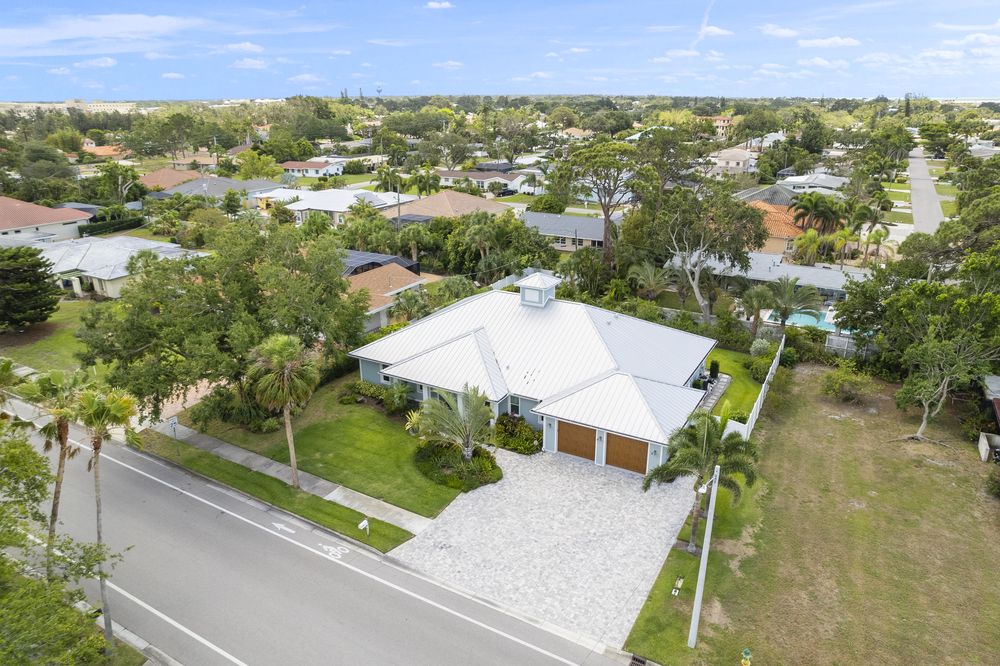
What licensed aerial work buys · Venice · Photo: Stellar Media Collective
Questions builders actually ask
Can my super just fly our company drone? Yes — once he holds a Part 107 remote pilot certificate. It's a knowledge test — airspace, weather, regulations, no flight demonstration — and genuinely passable for a motivated person; anyone who can read a set of plans and a survey can learn an aeronautical chart. Figure a couple of weekends of study, a modest test fee, and recurrent training. For monthly progress orbits without hiring out every one, it's one of the cheapest lines in the marketing budget.
Our crew doesn't mind the drone. Can it fly over them if they sign off? Consent doesn't change the rule. The over-people restrictions turn on the aircraft's operational category, not on whether your framers are relaxed about it. There's a carve-out for people directly participating in the flight operation — a visual observer, say — but a crew building a house isn't part of the flight operation. The workable answer is the professional one: plan paths and timing so the question never comes up.
It's my land. Do I still need airspace authorization? Owning the dirt doesn't exempt the air. If the site sits in controlled airspace near an airport — and much of coastal Florida does — authorization is required no matter whose name is on the deed. LAANC usually makes it a same-day formality, but it has to happen.
My videographer subs out the drone work. What paper do I collect? The same paper as if you'd hired the operator directly: the actual pilot's Part 107 certificate and an aviation liability COI naming you additional insured, from whichever policy covers the flight. Subbed-out aerial work is normal. Undocumented subbed-out aerial work is how you learn after the incident that nobody's policy applied.
Rules summarized in plain language as of July 2026; regulations change, and this is general guidance, not legal or aviation advice — verify current FAA guidance before operations. Disclosure: this publication is owned by Stellar Media Collective, whose drone work is flown under Part 107 by certificated pilots.