Filming Restoration Work After a Storm: The Ethical Playbook for Florida Contractors
Your camera can document help or harvest misery, and Florida homeowners can tell the difference from the driveway. The standards that keep storm filming ethical are the same ones that make it effective.
8 min read · July 6, 2026 · Florida Construction Media
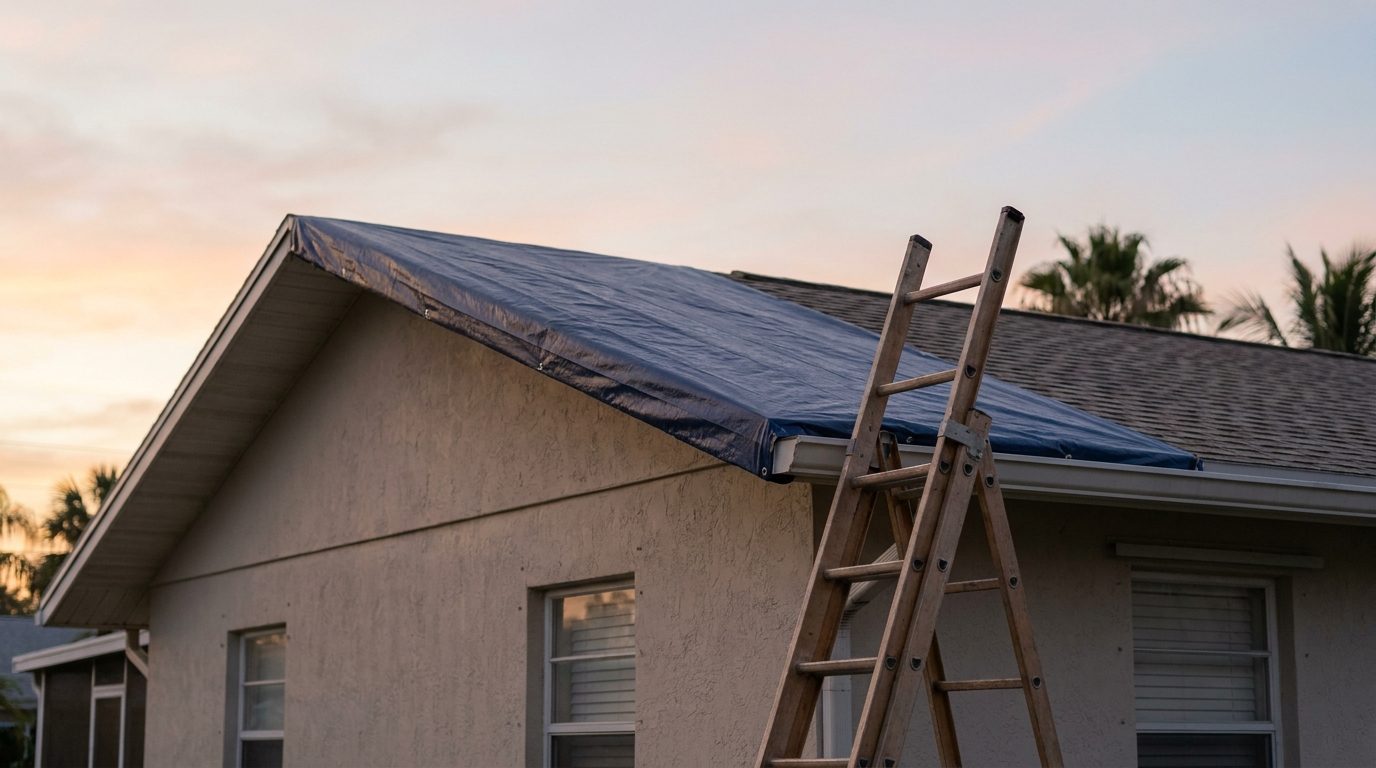
The week after a named storm crosses the Florida coast, the hardest-hit neighborhoods all sound the same: generator hum, chainsaws, trucks backing up. They look the same, too. Blue tarps going on roofs. Wet drywall stacked at the curb. And a steady traffic of work trucks — some local, plenty not, more than a few wearing magnetic door signs that went on somewhere north of the state line.
Standing in the middle of it is a homeowner about to make five-figure decisions in the worst week of their year, primed by the warnings state officials push out after every landfall: verify the license, don't pay cash up front, don't sign anything you don't understand. The wariness is earned. A decade of assignment-of-benefits abuse — and the run of legislative fixes it forced — taught Florida homeowners to read what a contractor hands them more carefully than the estimate. That homeowner is your audience. Earn their trust or leave the camera in the truck.
Because after a hurricane, a restoration contractor's camera does one of two things: it documents help, or it harvests misery. Homeowners here have been burned often enough to tell the difference on sight. That simplifies the question: the ethical line and the effective line are the same line.
The hard rules
This is not a values statement. Treat it the way you treat a safety program: written down, trained on, enforced, with no exception for footage that would have been great.
Written consent before any camera goes onto a client's damaged property. Not a nod on the doorstep. Someone three days removed from losing half a roof will agree to almost anything asked kindly, which is exactly why a verbal yes isn't worth much — to you or to them. One page, plain language, signed. If that feels like overkill for a tarp job, that's the correct read: most tarp jobs shouldn't be filmed at all.
Never film identifiable losses. Family photos in the debris. A child's bedroom open to the sky. Personal belongings at the curb, faces of people in distress. None of it, under any framing. No caption redeems it.
No cameras at first contact. The first visit is for the tarp, the extraction, the scope. Help first. The question about filming comes later, if it comes at all, and no is a complete answer that changes nothing about the work — not the schedule, not the price, not the attention the job gets. If your crew treats a declined release like a lost change order, fix the culture before you fix the content.
Drones carry their own rules and their own decency limits. After a major storm, emergency airspace restrictions routinely go up over damaged areas while rescue and utility aircraft work low; flying through one is a federal problem, not a marketing decision. The rules for legitimate drone work on Florida sites fill their own article. The decency limit is simpler: a slow aerial pan across a wrecked neighborhood is not your footage. It's several hundred families' worst week, shot from above.
Never stage or exaggerate damage. Not for the adjuster, not for the algorithm. In an insurance-funded trade, footage is evidence — date-stamped and discoverable — and staged damage is a confession with production values.
The consent standard: one page, plain language, covering four things — what gets filmed, where it runs (website, social, paid placement), the homeowner's right to revoke later and have it taken down, and no discount or incentive attached to signing. Consent traded for money isn't consent; it's a transaction, and it reads like one on camera.
Help first. Cameras later, with permission · Illustration: Florida Construction Media
Misery content fails on its own terms
Set the ethics aside and run it as a business case. Damage footage travels, because platforms reward strong emotion and a gutted living room is strong emotion. So the reel does numbers — views from three time zones away, comments from people who will never hire a Florida contractor for anything. Views from everywhere, clients from nowhere.
The only viewer who matters is the homeowner in your service area, and they're watching with one question running: will these people respect my home? A walkthrough of someone else's ruined kitchen answers that question the wrong way, permanently. And there's a cost nobody prices in: the family in that footage — and every neighbor who recognizes the house — is a referral you'll never see. In a trade that runs on referrals, that's not a rounding error.
What to film instead
Three buckets, and the calendar matters as much as the content.
Before the season. The content that positions you gets shot in May, not the day after landfall. How to read a roof before storm season. What shutters actually have to hold, and where the cheap ones fail. Generator basics, fuel safety, which mitigation projects earn their cost back. Explained by your own crew, on camera, in their own words — getting owners and supers comfortable saying it is a solved problem. The contractor who taught a homeowner something useful in May is the first call in September, and storm-week ad spend doesn't buy that position back.
During the response. Your process, never their loss. Mobilization out of the yard before dawn. Tarping done right next to tarping done wrong. What a drying protocol actually involves, day by day, meter readings on screen. What a legitimate scope of work looks like on paper, and why a vague one costs the homeowner at settlement. All of it filmable on your own equipment and sites, with no victim in frame — and exactly what a rattled homeowner is searching at midnight, trying to work out whether the person who knocked that afternoon is legitimate.
After, with consent. The restoration story gets told at the end, when the family has the house back and chooses to tell it. Ask when the punch list closes, not while the air movers are still running. Consent freely given months later, by people standing in their finished home, produces the only version of the story worth having — theirs, on their terms. It also produces the stronger film. Relief is more persuasive than wreckage ever was.
Say what a storm chaser can't
Storm season is the one stretch of the year when homeowners are actively coached to interrogate contractors. After every landfall, the Attorney General's office and the state licensing department push out the same guidance — unlicensed activity spikes after storms, penalties for it get stiffer during a declared emergency, verify before you hire. Read correctly, those warnings are a script request. The state is telling homeowners what to ask. Almost nobody on the contractor side bothers to answer on camera.
Answer. Put your license number on screen and say it out loud, then show viewers where to verify a license on the state lookup — starting with yours. Show the shop: the local address, the years in the county, crews that were here before the storm and will be here after, because a storm chaser can say all the right words and can't show any of this. Explain how an insurance scope actually works — who writes it, what a supplement is, why an offer to absorb your deductible is a red flag with legal weight behind it. Then walk through the questions a homeowner should ask any contractor after a storm — license, insurance, local references, written scope, permits — and invite them to ask you the same ones first.
None of that is inspired content, and it doesn't need to be. The fastest way to look different from a storm chaser is to be visibly, verifiably not one, and in the one week when every homeowner has been told to check, verifiable is the operative word.
Documentation before marketing
Restoration crews already film constantly: moisture readings, pre-mitigation conditions, scope photos, daily drying logs. That footage has a job. It supports the claim, protects the client in a dispute, and protects you in a supplement fight — and it belongs to the project file, not the feed. Shoot it with the client's knowledge and treat it as work product first.
If a project later becomes a story worth telling, some of that documentation becomes the most credible material you own, precisely because none of it was shot for marketing. That's the order of operations: documentation serves the claim and the client; marketing is a byproduct the footage earns later, with permission. Get the order backwards and homeowners can tell — it shows up in what the camera lingers on.

The coast between seasons · Sarasota Bay · Photo: Stellar Media Collective
Questions builders actually ask
Can I film from the street without permission? Legally, in most circumstances, yes — there's no general expectation of privacy for what's visible from a public right-of-way, which is why news crews do it. But legality and decency aren't the same standard, and this publication's standard is permission. A homeowner watching a contractor film their damaged house from the sidewalk doesn't parse what's lawful versus what's predatory, and neither do the neighbors watching from their own driveways. A news crew leaves after the segment; you're asking these same people to let you inside their homes. Different job, higher bar.
A homeowner offered to go on camera the day we tarped their roof. Should we take it? Thank them, note it, and don't shoot. Gratitude in week one is real, but it isn't a stable basis for consent — the homeowner who signs in month four, standing in a finished house, is agreeing for the same reasons they'd refer you to a neighbor. Ask again then. If it's still yes, you get a better film. If it's no, you lost nothing you were entitled to.
A competitor posts raw damage footage and the numbers are huge. Am I losing ground? Ask what the numbers are made of. Damage content travels because it's emotionally loud, and the distance is the problem — views from out of state don't request estimates. Meanwhile, the local homeowners who recognize the street draw the obvious conclusion about what their own worst week would look like in the hands of the account that posted it. That's not ground you want to gain.
Standards current as of July 2026. Published by Stellar Media Collective, Sarasota. This article carries no call to action by design; some subjects shouldn't share a page with a pitch.