The Job-Site Walkthrough: The 4-Minute Video That Outsells Your Portfolio Page
A gallery proves you can finish a kitchen. A four-minute walkthrough proves you can run a job site — which is the question a $200,000 client is actually asking.
9 min read · July 6, 2026 · Florida Construction Media
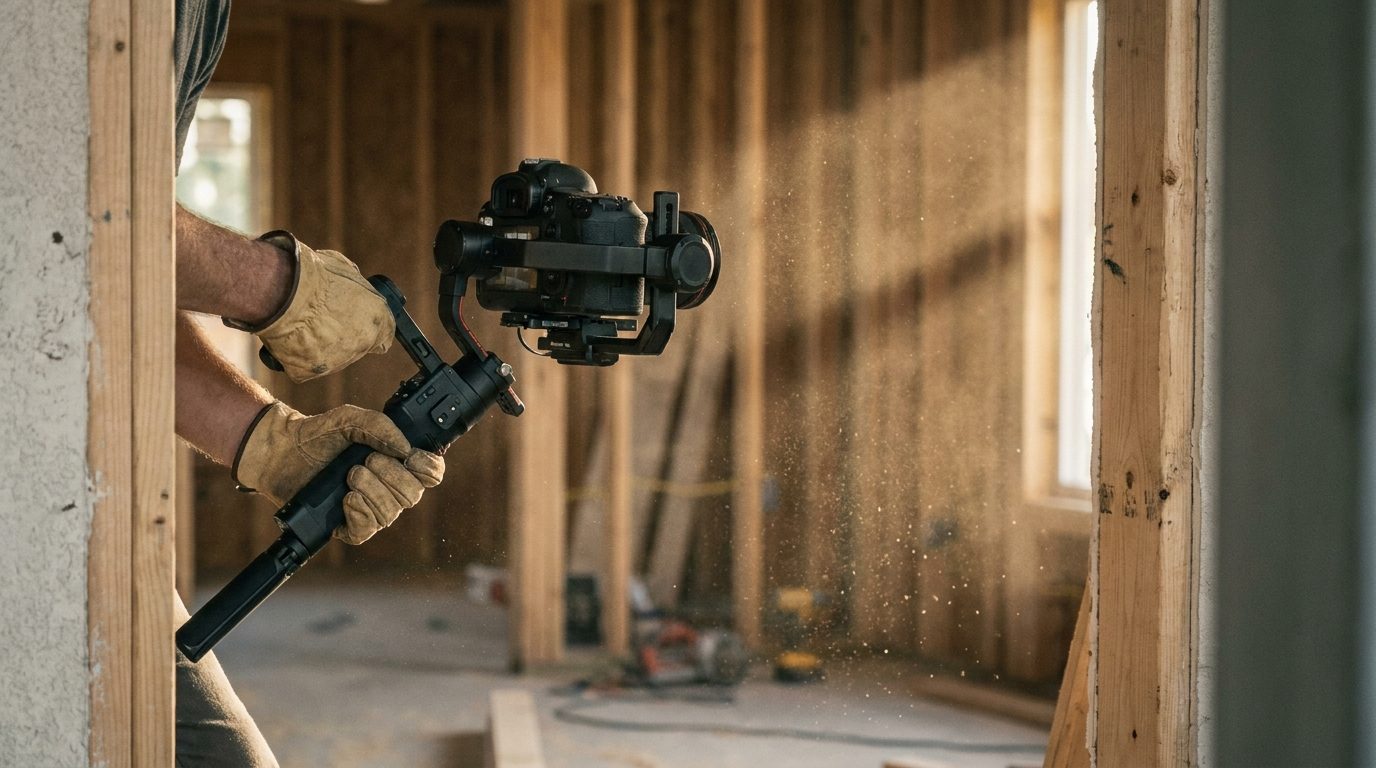
A homeowner about to sign a $200,000 remodel is not wondering whether you can build. Your finished work settled that before they called. What they're wondering, on their third late-night visit to your website, is what it will be like to have your company on their property for five months. Whether the site gets swept. Whether the crew that shows up Tuesday knows the plan. Whether anyone calls back when the tile question surfaces in week nine.
A portfolio page can't answer any of that. Twelve photos of finished kitchens prove you have finished kitchens — so has everyone else on the list. A four-minute walkthrough of one real project, narrated by you or your super while the site is still live, answers the actual question. That's why it outsells the gallery.
Why the walkthrough wins
A portfolio shows outcomes, and at the premium end outcomes are table stakes. What a walkthrough shows is process: floor protection down, dust barriers sealed, tools staged instead of scattered, a super who can explain why the header got upsized, trades that look managed rather than merely present. Those are the trust signals a six-figure client actually vets, because their fear isn't "will the kitchen look good." Their fear is the story a neighbor told them — the job that ran four months long with nobody answering the phone.
There's a second, colder reason: a walkthrough is hard to fake. Photos can be borrowed, staged, or inherited from whoever owned the company name last. Four unbroken minutes of your people on your job site is proof of possession in a way a gallery never is.
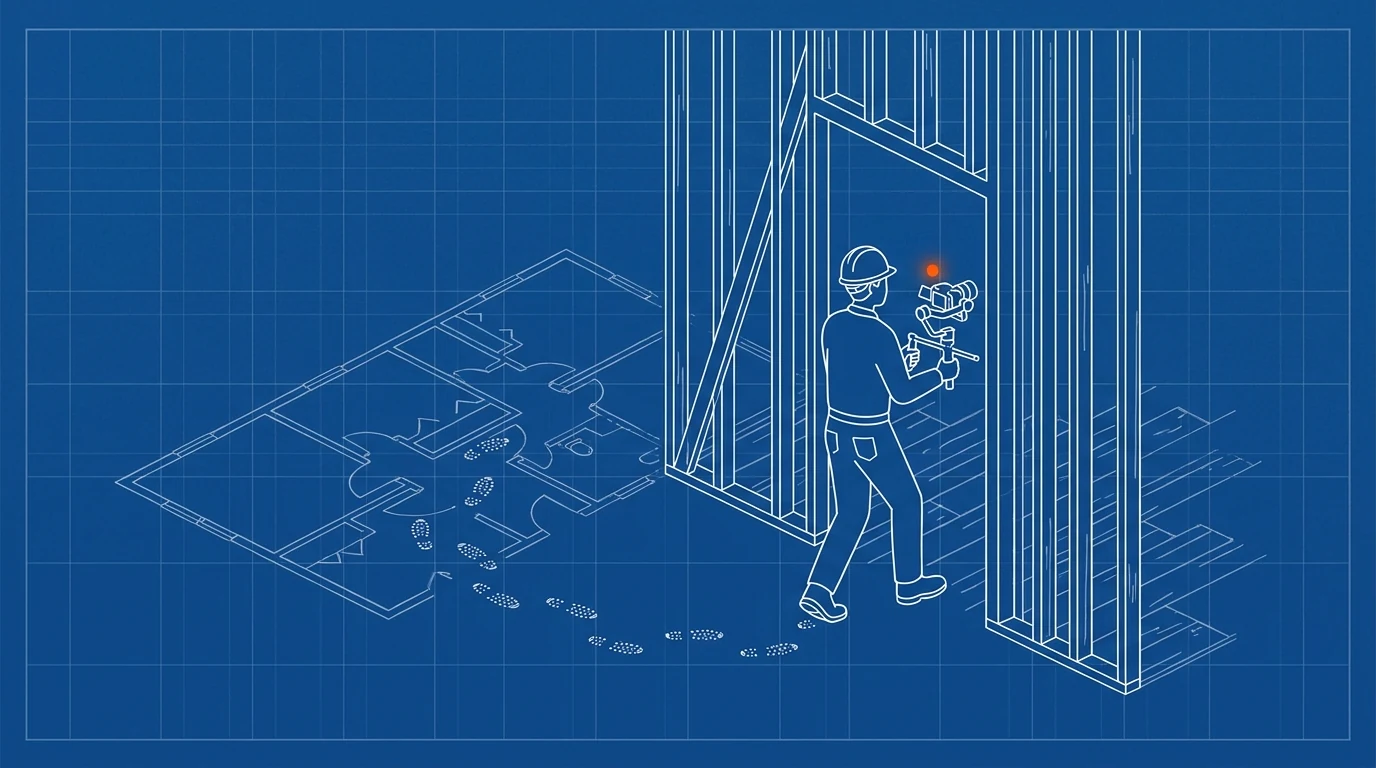
One walk, one take — the floor plan does the talking · Illustration: Florida Construction Media
The four-minute structure
Four minutes is a deliberate number: long enough to demonstrate how you run a job, short enough that a serious prospect finishes it. The skeleton is the same problem–process–payoff arc we laid out in the three-act project story, compressed onto a clock.
0:00–0:30 — The hook. Open on the problem this project solved, not a drone orbit of the roofline. Something like: "The owners had a 1978 ranch with a kitchen you couldn't stand in with the fridge open — and a hard budget." Who, what was wrong, the constraint — one line each. The constraint is what makes the rest credible.
0:30–2:00 — The walk. The narrator moves through the main spaces and explains what changed and why. It's the longest block because it does the selling: the viewer is watching how your company thinks, communicates, and keeps a site.
2:00–3:15 — The craft and the trades. Get close. Tile layout at the edge, the scribed panel, the trim carpenter mid-task. Name the trades and let them be seen working.
3:15–4:00 — The reveal, and who it's for. The finished space in the best light of day, held longer than feels comfortable. Then the narrator says plainly what kind of client and project this company fits. A straight qualifying statement filters the wrong calls and emboldens the right ones.
Spec box: Rules for the cut.
- Runtime 3:30–4:30. If it needs six minutes, that's two videos.
- One project per video. A montage of five jobs proves nothing about any of them.
- Narrator on camera inside the first 20 seconds.
- Music under the voice, never over it — the prospect is vetting the voice.
- Shoot 16:9; derive verticals in the edit, not on set.
The shot list
Hand this to whoever is filming — your PM with a phone or a hired crew, it's the same list. Before anyone records a frame: broom-clean the work areas, coil the cords, stage the tools, get the lunch trash and the porta-john out of frame, and brief the crew a day ahead — company shirts, radios down, keep working, ignore the camera. You're not faking a clean site; you're showing it the way you'd show it to the client.
| Shot | What it shows | Why it matters |
|---|---|---|
| Curb arrival, wide | Lettered truck, protected walkway, dumpster placement | The client's street-view first impression; order reads from thirty feet |
| Narrator intro at the entry | Owner or super walks into frame, gives name, role, and the project in one line | Puts a face and a voice on the company inside 20 seconds |
| The before evidence | Plans on a table, before photos, or the untouched adjacent room | Establishes the problem the whole video answers |
| The tracking walk | Camera follows the narrator room to room | The spine of the piece; walking and talking is the product demo |
| The decision shot | Narrator gestures at the moved wall, upsized header, relocated island | Trade-offs are proof of judgment; this is the shot that sells |
| Site protection | Floor paper, zip walls, sealed returns, clean paths | The silent number-one worry of anyone living through a remodel |
| Trades at work | Tile setter, electrician, or trim carpenter mid-task, aware they're on camera | A managed crew beats any claim you could make about one |
| Craft close-up | Hands on a miter, scribe line, tile edge, cabinet reveal | Craft reads at six inches; wide shots flatten it |
| Materials insert | Slab, flooring, hardware laid out on a clean surface | Premium selections justify premium numbers without saying so |
| Communication artifact | Schedule on the wall, super walking a plan sheet with a sub | Answers "will I know what's happening on my job" |
| The reveal | Slow walk or push into the finished space, best natural light | The payoff; hold it a beat past comfortable |
| Narrator close | To camera: who this project was for, who the company fits | Qualifies the next caller before the phone rings |
| Insert pickups | Ten to fifteen quick details, five seconds each, grabbed at the end | Edit glue — covers narration cuts so the pacing holds |
What the narrator actually says
The failure mode is always the same: adjectives. "Beautiful open concept." "Stunning custom finishes." The viewer can see the video; describing it is wasted air. Narrate decisions instead:
- "We moved this wall eight inches because the island needed forty-two inches of clearance on both sides."
- "The clients wanted the look of full-slab backsplash on a tile allowance, so here's the compromise we engineered."
- "The inspector flagged the old panel, and this is what we did about it and what it cost."
- "This beam is the reason the ceiling could go flat — and the reason the schedule gained a week."
Decisions demonstrate judgment, and judgment is what a premium client is hiring. Anyone can say beautiful; only the person who built it can say why.
If you or your super lock up when the lens comes out, that's fixable — our owner-on-camera scripts exist for exactly this. If nobody will face the camera at all, shoot the walk silent and record the narration over the footage afterward; a quiet room and a phone voice memo is serviceable. The bar is competence, not charisma. A super explaining a header in a flat voice outsells a hired host, because the viewer isn't grading delivery. They're auditioning the person who would run their job.
A phone with a plan, or a crew
Both are legitimate buys. They're different line items.
The phone tier. Any recent phone shoots footage good enough for this job. What it can't fix is audio or planning, so the plan is: a wireless lapel mic — figure $150 to $300, and it's the one purchase that matters, because viewers forgive soft images and abandon bad sound — horizontal orientation, exposure locked on the narrator's face, and the shot list above on a clipboard. The trap isn't the shoot; it's the edit. Cutting forty minutes of clips into four is where DIY projects die, so budget an evening or two, or a few hundred dollars to a freelance editor with this structure as the brief. Right when: you're making one per quarter, the narrator is willing, and this isn't the flagship.
The hired tier. Figure $2,500 to $6,500 for a produced walkthrough in most Florida markets, because you're buying a half-day to a full day on site plus two or three days of editing, and crew day rates put the math there. What the money buys: interiors lit properly, clean audio nobody babysat, an interviewer who pulls the decision stories out of your super, and an edit you never touch. The full breakdown of what moves those numbers is in our pricing article. Right when: this is the flagship project for the work you want more of, and the video will front your website for two years. One influenced signing on a $200,000 job pays for it several times over — the arithmetic isn't subtle.
Where it goes to work
A walkthrough parked on a "Videos" page is a tool left in the truck. Put it where decisions happen. Embed it at the top of that project's own page — that page becomes the link you send prospects before the first meeting, which sets the frame before price talk starts. Post the full version to YouTube titled the way people search: "Whole-home remodel walkthrough — 1970s ranch, Sarasota" beats "The Hendricks Residence," because prospects search project types and places, and search engines surface video for those queries.
Then cut it down. The four-minute master yields a 60–90 second trailer for the homepage, three or four vertical clips for Reels and Shorts — the decision shot, the craft close-up, the reveal — a before-and-after clip, frame grabs for the Google Business Profile, and narration pull-quotes for captions. That's one mobilization producing seven or eight publishable pieces, roughly a quarter's worth of posting. The cut-downs are where the reach is. The master is where the trust is.
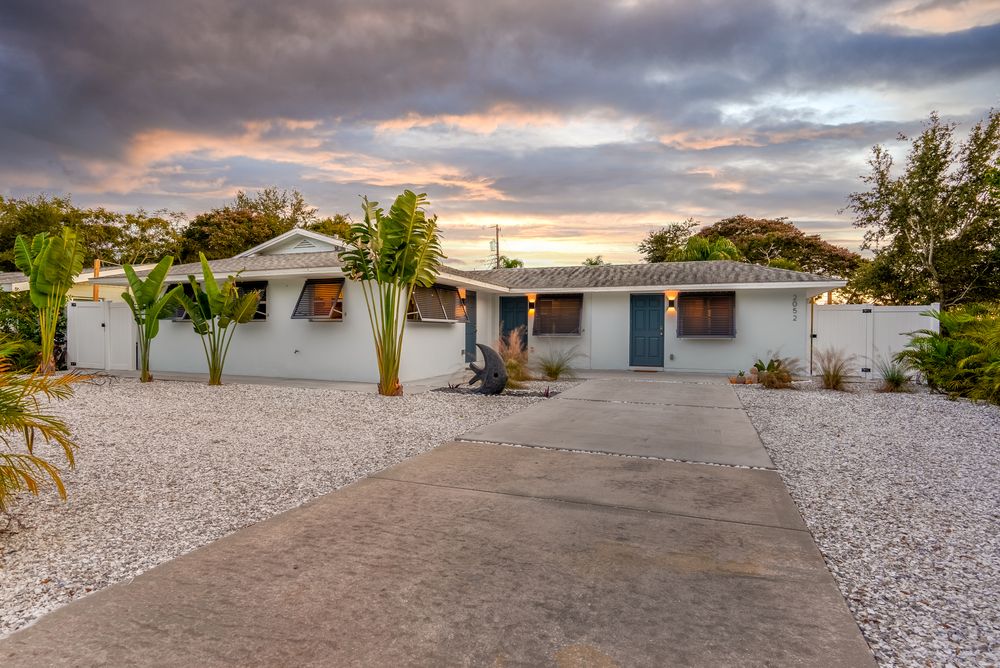
The walk starts at the curb · Jo-An Dr, Sarasota · Photo: Stellar Media Collective
Questions builders actually ask
Do I need the homeowner's permission? Yes, in writing, and the time to get it is at contract signing — a media clause with a plain opt-out, not a favor asked in month four. Most premium clients agree if you keep names and street numbers out of it; an interiors-only restriction is workable too.
When in the build do we shoot? The sweet spot is roughly 85 to 95 percent complete: finishes read on camera, but trades are still on site for the process shots. If you can manage two short visits, add one at rough-in, where the decisions are still visible in the framing.
Does anyone actually watch four minutes? Not everyone, and that's the point. Casual scrollers get the cut-downs. The full version is for the prospect comparing three builders with a deposit ready — and the viewer who finishes it is precisely the one worth a first meeting.
Practice described here is current as of July 2026. Disclosure: this publication is owned by Stellar Media Collective, a Sarasota video studio that produces walkthroughs like the ones described — the playbook works whether or not you hire one.