Video Marketing for Kitchen & Bath Remodelers: The Dust-to-Done Story System
Kitchen and bath clients aren't buying cabinets; they're buying six weeks of you in the middle of their household. Dust-to-Done films how you handle the dust, the days, and the decisions — and turns every job into the proof that sells the next one.
8 min read · July 6, 2026 · Florida Construction Media
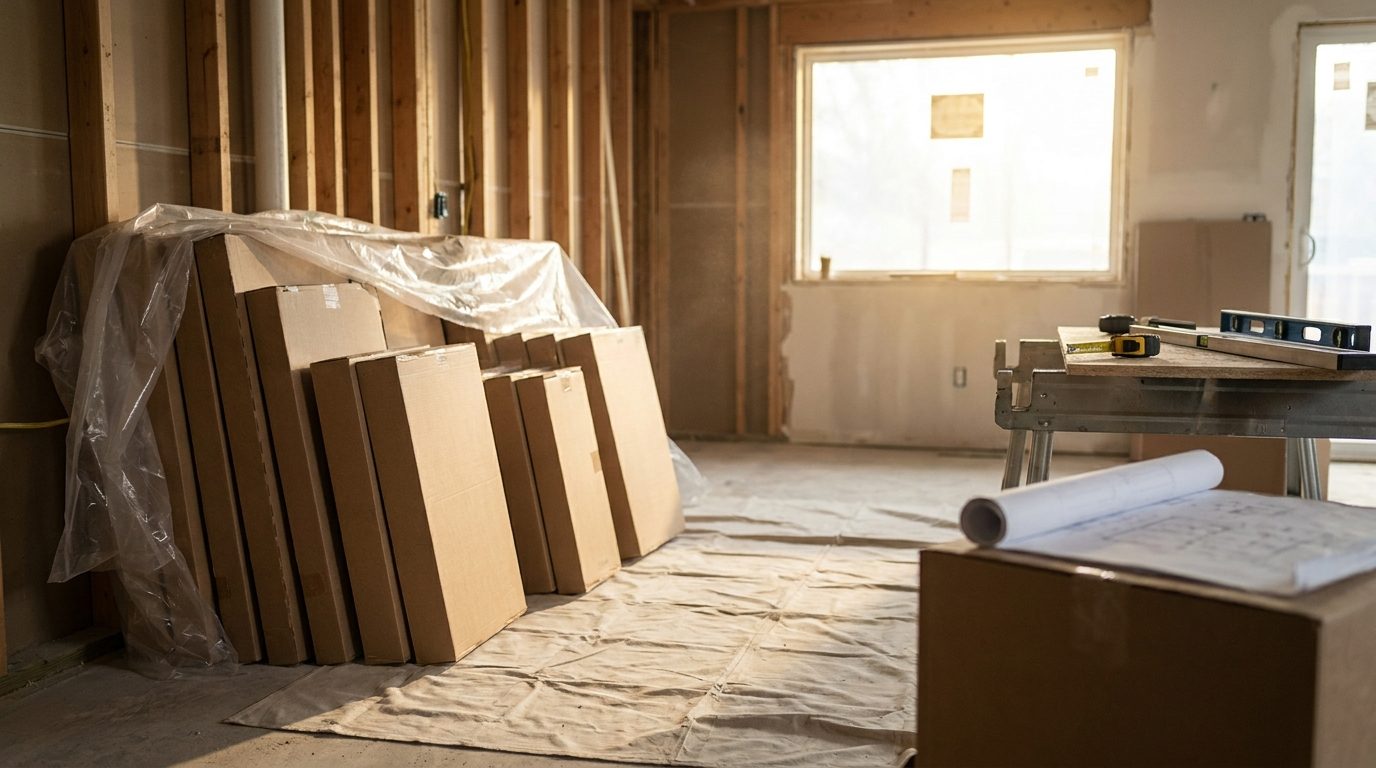
Ask a couple why they've lived ten years with a kitchen they hate and you'll rarely hear about money. You'll hear about the mess. A roof job happens above a family's life and a pool cage happens beside it; a kitchen remodel happens in the middle of it, with everyone still home. The kitchen is the household's operating system — coffee, homework, dinner, the dog's bowl, all of it routes through one room — and a remodel takes that room offline for six weeks while the family keeps living around the outage. Baths are the same anxiety at smaller scale: one less working bathroom in an occupied house is a negotiation every morning.
That makes kitchen and bath the highest-anxiety category in residential remodeling — and it changes what your marketing has to do.
Dust, days, decisions
The default marketing asset in this category is the finished photo: waterfall island, brass pulls, morning light nobody has cooked under yet. It answers a question no client was asking. Every remodeler within fifty miles can produce a pretty after. What a kitchen client is actually vetting is whether you can run a construction project inside a working household without wrecking it. Three fears, specifically: dust — can you contain the mess; days — can you hold a schedule a family can plan around; decisions — what happens when you open the wall and find something.
The content that wins kitchen and bath is the content that proves those three things, and none of them shows up in an after-photo. A homeowner has no way to evaluate your tile work. They can absolutely evaluate whether your job site looks controlled, whether your updates arrive on schedule, and whether the builder on camera sounds like someone who has seen the inside of a wall before. Proof of process beats promises of outcome, and in this category the process is the product.
The room every buyer judges first · Illustration: Florida Construction Media
The Dust-to-Done arc
Dust-to-Done is a filming system, not a video shoot: five beats, captured mostly on a phone by people already standing on the job, that tell the one story a kitchen prospect wants to hear — what it's like to be your client between the first drop cloth and the final walkthrough.
Day zero: film the protection ritual. Before demo starts on a well-run job, something almost ceremonial happens: floor protection rolls out and gets taped at the seams, the zip wall goes up with its zipper door, vents get sealed, the extractor hose gets clamped to the saw. Film all of it. It's the least glamorous footage the job will produce and the most persuasive: dust is the veto vote in most kitchen decisions, and nobody shows the containment — every competitor's feed is pendants and countertops. Thirty seconds of a hallway being sealed off tells a prospect more about how their project will go than any drone pass over the finished island. The protection is the differentiator. Film it the way other builders film backsplashes.
Demo day, told straight. Demo is the best raw footage a remodel produces, and the temptation is to cut it like an action reel. Keep the first cabinet coming off the wall — but keep the discovery too: the corroded shutoff, the junction box someone buried in 1989, the subfloor that explains the soft spot. Narrate it where it happened, the day it happened, with what you're doing about it. A builder who explains findings on camera during this job has pre-answered the change-order conversation on the next one. Honesty filmed in advance is credibility you get to spend later.
The mid-job update: one recording, two jobs. You should be sending the client a short weekly update anyway — what happened, what's next, what decision we need by Friday. Record it as a ninety-second walkthrough to camera instead of typing a paragraph. The client gets a calmer week. Trimmed and posted with their permission, the same recording becomes the most reassuring thing a prospect will find on your feed: a builder who communicates on a schedule, as a habit. Every remodel horror story stars a contractor who went quiet. This is the rebuttal.
The small-craft moments. Ten to twenty seconds each: a level bridging two tiles for a lippage check, leveling clips going in, a filler strip scribed to a wall that hasn't been plumb since 1978, the cabinet run shimmed dead level. Homeowners can't judge tile work, but they can recognize care when they watch it happen. These clips teach a prospect what the gap between your number and the cheap bid is made of, without you saying a word.
Reveal day, and the ask. The walk-in can't be reshot, so treat it as the scheduled event it is: camera rolling before the family enters, wide enough to catch the first reaction. Then ask for the testimonial right there — at the reveal, not a week later by email. At the reveal the relief is still in the room and the words come out specific; a week later you get a polite paragraph. The timing, the questions, and the release form are covered in the testimonial system.
Spec box: The every-job shot list — one phone, ten clips. (1) Floor protection going down, seams taped. (2) Zip wall up, zipper door closed. (3) Extractor running on the saw. (4) First cabinet off the wall. (5) The discovery, narrated where it happened. (6) One weekly ninety-second update to camera. (7) A lippage check or leveling clips going in. (8) A scribe, a shim — any ten seconds of fitting. (9) Cabinet or countertop install underway. (10) The reveal, camera rolling before the family walks in.
One kitchen, a month of content
Filmed this way, a six-week kitchen produces a publishing calendar with no extra site visits. One clip a week, each aimed at a different person in the buying conversation:
| Moment | The clip | Who it convinces |
|---|---|---|
| Day-zero protection | Thirty seconds: paper down, zip wall zipped, extractor on | The spouse whose real objection is the dust |
| Demo day | Forty-five seconds of teardown, discovery included | The buyer bracing for surprises and change orders |
| Mid-job update | Your client walkthrough, trimmed with permission | The family that has heard the ghosting stories |
| Craft close-up | Fifteen seconds: lippage check, scribe, shim | The prospect holding a cheaper bid |
| Reveal | The first walk-in, then the finished pans | Everyone — it pays off the other four |
The same footage also assembles into the long-form piece — the full project story, homeowner narrating — a different asset for a different moment in the decision. The structure for that film is the three-act project story. The weekly cuts get you found; the long cut gets you hired.
Filming in a house that's still a home
Kitchen and bath work happens in occupied homes, which makes your camera a guest in someone's private life. The etiquette is not optional — and, conveniently, it is itself the message.
- Consent at contract, confirmed at the door. A media clause in the agreement, raised at signing, re-confirmed verbally on day zero. Make no easy to say; a no is a no, and the system runs on the next job.
- Film your work, not their life. Your zip wall, not their dishes. Your floor protection, not the photos on their refrigerator. If a shot needs the family's belongings to make sense, it's the wrong shot.
- Sweep the frame before you roll. Mail, prescriptions, kids' artwork with names on it, screens, anything showing an address or an alarm panel — the end-of-day-cleanup discipline, applied to the lens.
- Announce the camera, and hand over the veto. Nobody living in that house should be surprised to find themselves online. The client sees any cut that shows their home before it posts, every time.
A crew that films this carefully is a crew that works this carefully, and homeowners make exactly that inference.
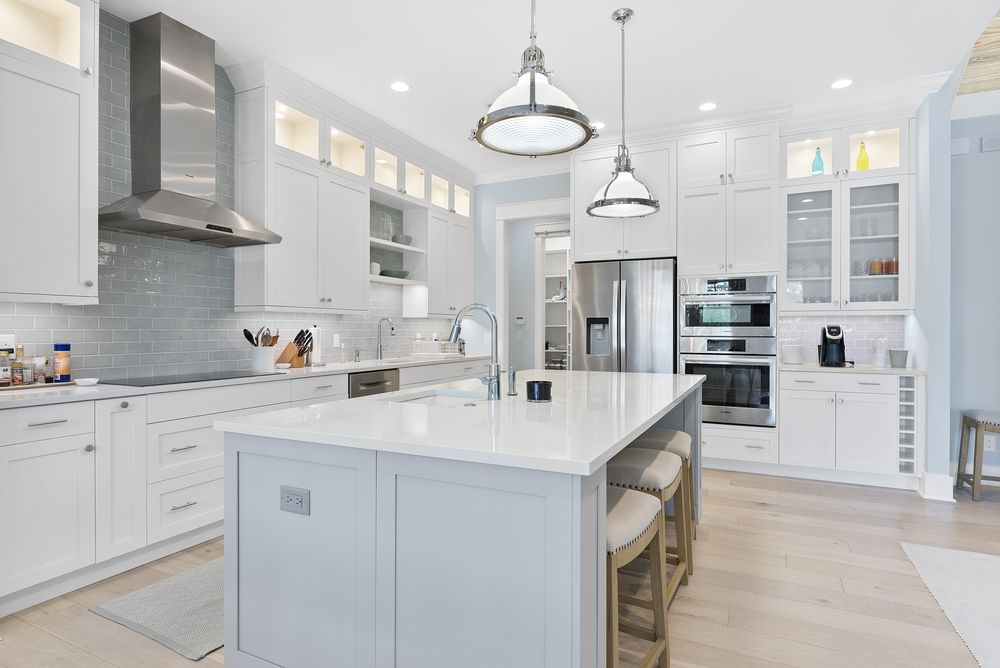
Done — and worth every day of dust · Venice · Photo: Stellar Media Collective
Questions builders actually ask
Who's supposed to film all this? My lead carpenter has a job to do. The arc is five scheduled beats, not a documentary crew. Day zero is twenty minutes with a phone. The weekly update is the ninety seconds your PM was going to spend writing an email. Craft clips take whoever is doing the work propping a phone against a paint can. Across a six-week kitchen that's roughly an hour of camera time — and if you hire a studio, the arc tells them exactly which four or five visits to make instead of billing for days of standing around.
My clients don't want their kitchen on the internet. Some won't, and asking costs you nothing — which is why it's a contract-stage conversation, not a reveal-day ambush. Offer the private version: no faces, no exterior, no last name, just the work. The system doesn't need every job, either — one filmed kitchen a quarter keeps the calendar full, so even if most clients decline, the machine still runs.
We already post finished kitchens and they get plenty of likes. Likes mostly come from other contractors, your crew, and past clients. After-photos prove the ending, and the ending was never the fear stalling your next prospect's signature. The protection clip, the narrated discovery, the visible update habit: that footage is the tiebreaker because almost nobody publishes it. The homeowner who watches a zip-wall video to the end isn't scrolling for fun. They're vetting you, this week, for a job they've been putting off for years.
Published July 6, 2026. Disclosure: Florida Construction Media is owned by Stellar Media Collective, a Sarasota studio that films kitchen and bath projects for remodelers across the Gulf Coast; the system above works the same whoever holds the camera.