What Lead-Gen Platforms Actually Charge Premium Trades, and the Owned-Media Alternative
Angi, Thumbtack, Google's Local Services Ads and Houzz Pro, priced from their own pages and filings, then run through the only number that matters: what a signed job costs, and what you own when you stop paying.
8 min read · October 1, 2026 · Florida Construction Media

Every lead-gen platform sells the same thing: a homeowner who is ready to talk, delivered to your phone, for a fee. For a trade that needs the phone to ring this month, that is a real product and sometimes a good one. The trouble starts when a builder tries to answer the obvious question, which is what it costs, and finds that most of the platforms will not print the answer.
So we went to the sources the platforms can't argue with: their own help pages, their pricing pages, and, for the one that is publicly traded, its SEC filings. Where a platform does not publish a number, we say so instead of filling the gap with a guess. Then we run the figures through a cost-per-signed-job model, assumptions printed, and price the alternative: media you own.
What the platforms actually publish
Google Local Services Ads. Google's help center says you are charged for each valid lead, meaning a call, message or booking request through the ad, and that the price varies by location, job type, type of lead and bidding mode. Message leads are typically priced lower than calls. Google does not publish a price list. Leads its models later judge to be low quality can be credited automatically, usually within 30 days. And the product itself is moving: starting in August 2026, Google began migrating select U.S. home-service advertisers into Performance Max campaigns with pay-per-lead goals, run from the main Google Ads account.
The closest thing to a public price is third-party. One marketing agency, SearchLight Digital, tracked $6.72 million of LSA spend across 888 home-services contractors in February 2026 and reported a blended $53 per lead, from $39 for electrical to $59 for drain and sewer. That is one agency's client book, and it is all service trades. Remodeling and custom building are not even a line item.
Thumbtack. The pro sets an exact price per lead for each service, inside a weekly budget, and Thumbtack sets minimum prices it says it may adjust. Thumbtack publishes no price list; it says the cost aims to match how valuable the job is, and a higher bid makes you more competitive. Two terms matter more than the price. A customer can contact up to five pros in the first four hours of a search, and more after that. And if the customer replies to none of them within 72 hours, the lead is refunded automatically.
Angi (including HomeAdvisor). No public price list. Angi's 2025 annual report describes lead revenue as fees paid by pros for consumer matches "regardless of whether the Pro ultimately provides the requested service," varying by service, product and geography. Pros buy full-priced leads within a monthly budget, discounted leads in a subscription package, or a la carte. The Q2 2026 earnings release gives enough to compute an average: Angi defines revenue per lead as U.S. revenue divided by leads, and $215.4 million over 4.84 million leads works out to roughly $45 per lead, blended across every trade and including subscription and advertising revenue. The same release shows average monthly active pros down 17 percent year over year, to 106,000.
Houzz Pro. The one platform with a public menu. Software plans run $99, $199 and $399-plus a month on an annual subscription, and the local advertising package starts at $499 a month. That is a monthly fee for exposure, not a per-lead price, so cost per lead depends entirely on what the ads produce in your ZIP codes.
Porch does not publish contractor pricing that we could find, so it is not in the math.
For calibration, the do-it-yourself version of rented demand is paid search. LocaliQ's 2026 search advertising benchmarks put the average cost per lead in Home and Home Improvement at $90.92, across its clients' Google and Microsoft campaigns.
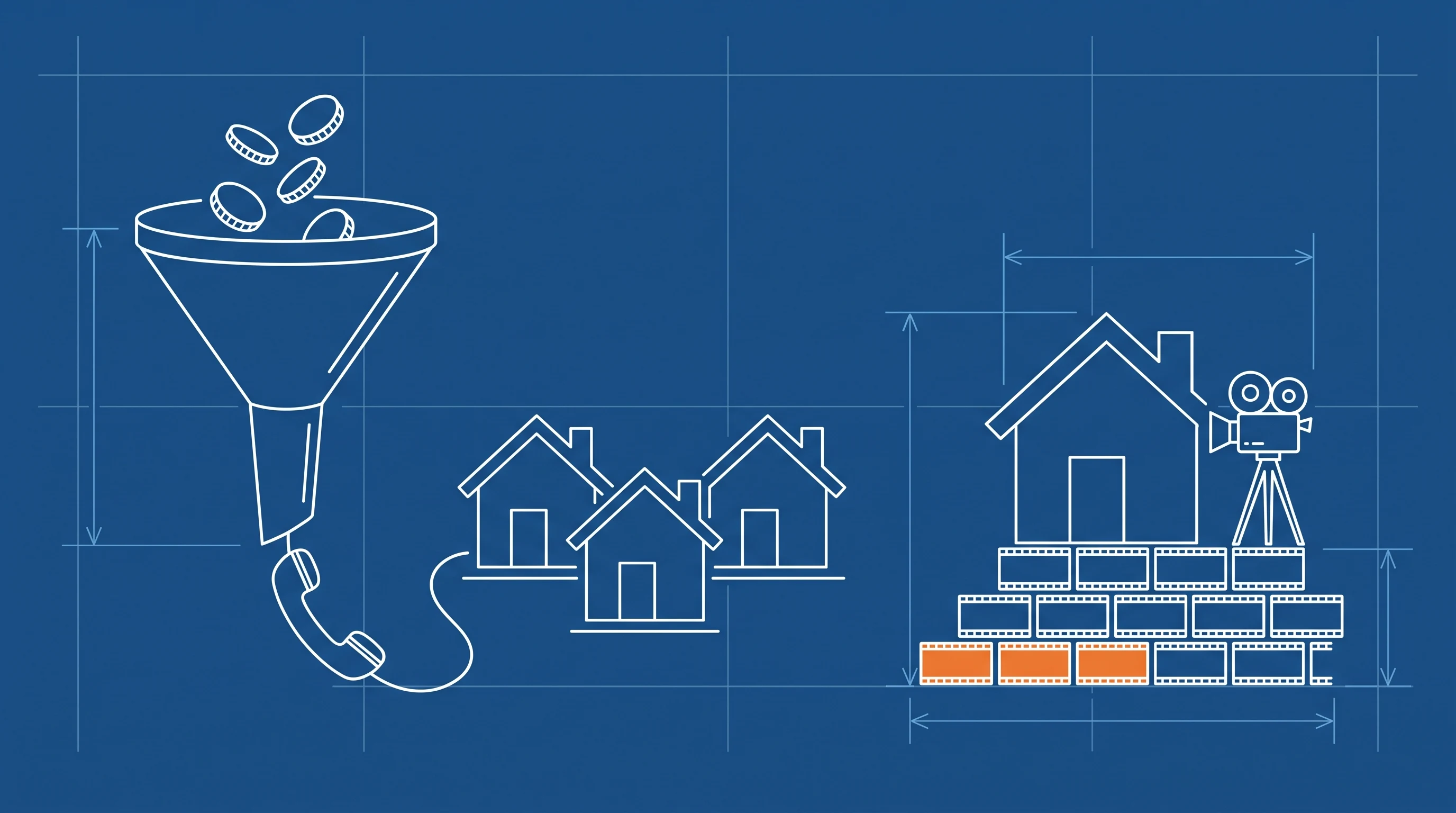
Rented demand versus a foundation you keep · Illustration: Florida Construction Media
The number that matters: cost per signed job
A lead price is an input. What you are buying is a signature, so divide by your close rate. The table below is a model, not data: the lead prices bracket the sourced figures above and allow for premium categories pricing higher, and the close rates are assumptions you should replace with your own.
| Lead price (assumed) | Close 1 in 10 | Close 1 in 20 | Close 1 in 40 |
|---|---|---|---|
| $50 | $500 | $1,000 | $2,000 |
| $100 | $1,000 | $2,000 | $4,000 |
| $200 | $2,000 | $4,000 | $8,000 |
Now hold it against the job. In our lifetime-value model for a $250K remodel, layer one alone, the gross profit on the job itself, came to $55,000 to $75,000. Even the worst cell in the table is under 15 percent of the low end.
That is the honest finding, and it cuts against the usual contractor complaint: on paper, platform leads can pencil for premium work. The fee is rarely what makes them a bad buy. Three costs that never appear on the invoice do.
You arrive as one of several. Thumbtack says customers usually contact fewer pros than its limit of five, but a homeowner messaging even three pros is running a comparison, and comparisons drift toward price. Everything that justifies a premium (your process, your finish standard, the way you run a site) has to be proven on the first call, against everyone else on the thread trying to do the same.
The buyer does not know you yet. A platform delivers the small slice of the market that is ready to hire today. The much larger group that will hire in a year or two, the 97 percent, is never on the platform's invoice, and it is the group that decides who gets the first call when its turn comes.
Nothing accrues. The reviews, the profile and the ranking live on someone else's site, under rules that change: Thumbtack's minimums, Google's migration, an annual renewal. Turn off the budget and the phone goes quiet the same week. Every dollar was spent on this month.
Rule of thumb: judge a platform by cost per signed job in your bracket, not cost per lead, and measure it over two quarters. If it pencils, keep it as a faucet. If it only pencils on the jobs you didn't want, you are paying to be price-shopped.
The owned-media alternative, priced the same way
Owned media is everything that keeps working after the invoice is paid: project pages on your own site, a Google Business Profile full of real work, films of finished jobs, a list of past and future clients you can email. It is not free, and it is not fast. A library takes months to build, and the first quarter usually produces nothing you can point at. Anyone who promises otherwise is selling you a platform with extra steps.
Run it as the same comparison. A $1,500-a-month platform budget is $18,000 a year, and its balance on December 31 is zero. The same $18,000 spent on owned media leaves you a stack of assets: what it buys depends on the mix, and our video cost guide prices the options line by line. Each piece keeps answering the question a premium buyer is actually asking (can this builder do work like mine?) for years. And it changes how a lead arrives. A homeowner who watched your kitchen walkthrough, read the project page and saw your super explain the slab cure calls already sold on you. That is a different phone call from one of several.
Most builders shouldn't choose. The play that holds up is to use platforms as a faucet while the owned library grows, and to route every platform lead into owned media immediately. Send the project film for a job like theirs before the site visit. Answer the price question with a proposal walkthrough, not a number in a chat window. A rented lead becomes an owned relationship the moment it sees your work on your own ground. Stellar's guide to proof over lead volume covers what that library should contain, and the kitchen and bath remodelers page shows it applied to one trade.
One more data point is worth weighing. In 2023 the FTC finalized an order requiring HomeAdvisor to pay up to $7.2 million, settling charges that it misrepresented the quality of the leads it sold and the rate at which they turned into jobs. Whatever you buy, track the outcome yourself. Attribution without fantasy is the method we'd use.
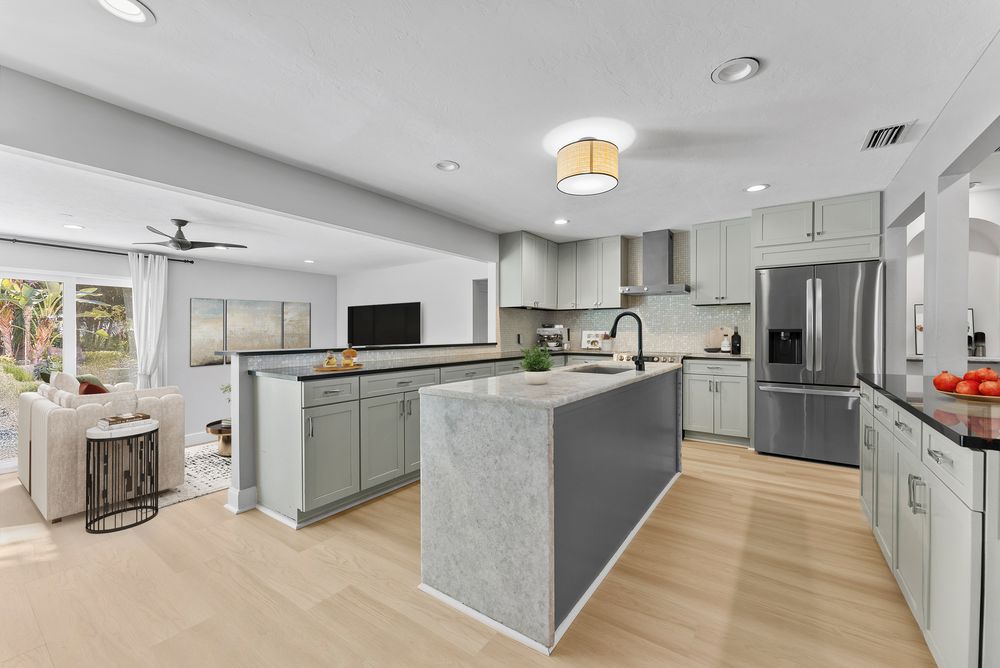
The job the lead fee is supposed to buy · S Orange Ave, Sarasota · Photo: Stellar Media Collective
Questions builders actually ask
Why won't the platforms just publish their prices? Because the price moves with the job type, the location, the competition and, on Thumbtack and Google, your own bid. Angi's annual report says outright that lead revenue varies by service, product and geography. The practical answer: ask for your price in writing for your category and ZIP codes before you fund anything, and look at it again every quarter.
Are shared leads always bad? No. For service work where the homeowner needs someone Tuesday, speed wins and sharing is fine. For a $250,000 remodel, the buyer is choosing a relationship for most of a year, and starting that relationship in a side-by-side comparison is a handicap you have to overcome on the first call.
What close rate should I plug into the model? Yours, from your own records, split by source. If you don't track it, track it for a quarter before you change anything. The table above is only as good as the column you read from.
Should I quit the platforms? Not on principle. Quit the ones whose cost per signed job you can't defend, keep the ones you can, and start building the library that makes you less dependent on all of them. The goal is a phone that rings when the budget is off.
Platform terms and figures were checked against the pages and filings linked above on October 1, 2026; they change often, and the cost-per-signed-job table is a model whose lead prices and close rates are assumptions. Disclosure: this publication is owned by Stellar Media Collective, which sells the owned-media side of this comparison. Weigh the argument accordingly; the platform figures are sourced, and the arithmetic works the same with your numbers in it.