The Proposal Video: A 3-Minute Walkthrough That Closes Estimates
Your best proposal gets forwarded to a decision-maker who never met you and never saw the site. A three-minute video, recorded on your phone and sent with the PDF, puts you in the conversation that actually decides the job.
7 min read · July 6, 2026 · Florida Construction Media
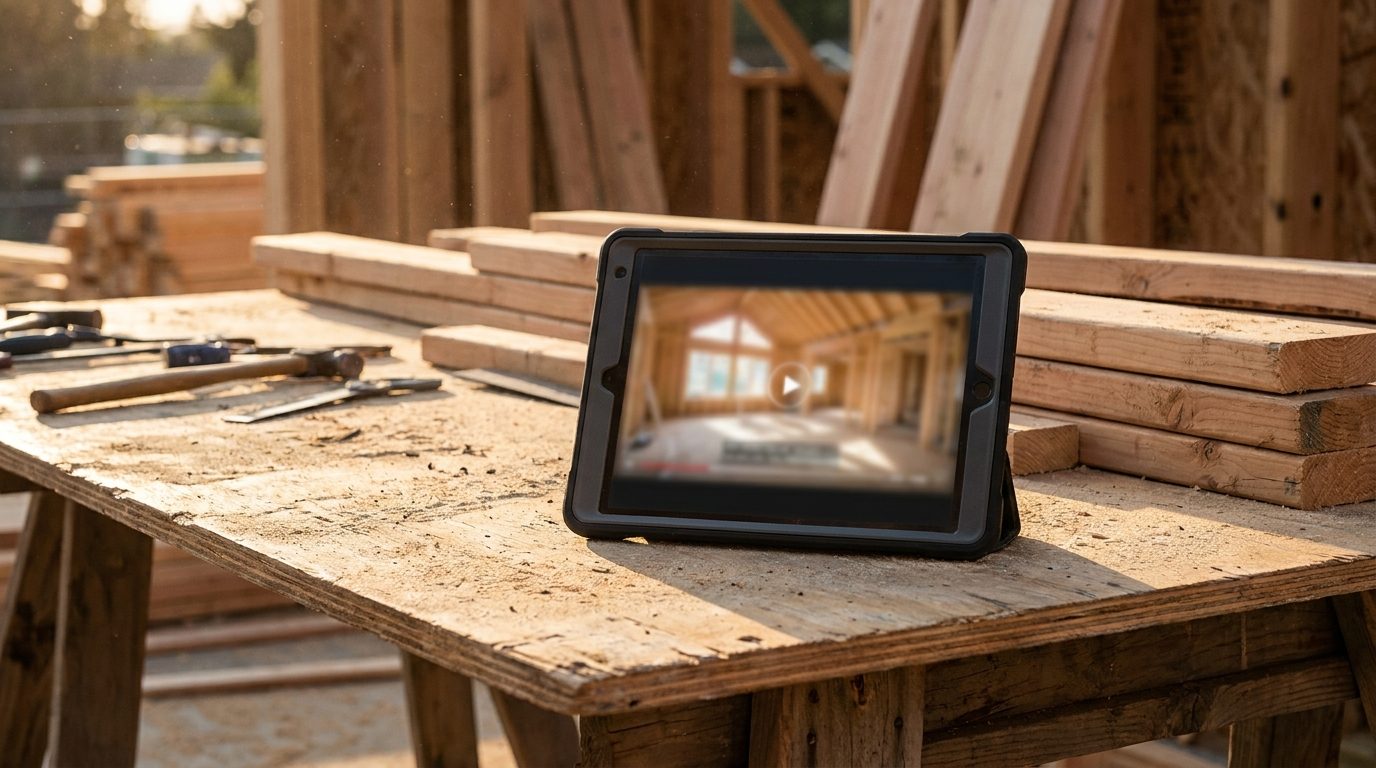
You send the $180,000 proposal at 4:40 on a Thursday, feeling good about it. The site visit ran long in the best way, the questions were sharp, the client nodded in all the right places. By eight that evening the PDF has been opened, read the way proposals get read — the first paragraph and the total — and forwarded to the person with the most say over what happens next: a spouse who wasn't at the meeting, never walked the site, and has never seen your face.
The decision now happens at their kitchen table, between two people. One of them spent ninety minutes with you. The other met a PDF. Nothing in the document fixes that. A proposal answers what it costs; it is structurally incapable of answering who you are — and at six figures, that second question breaks the tie.
The proposal video is the repair: three minutes of you on camera, recorded right after you write the estimate, sent in the same email as the number. It puts you in the decision conversation you were never going to be invited to.
Three minutes, minute by minute
The format is deliberately rigid: three minutes, your face, their project. A phone propped on the tailgate is plenty — nobody is grading production, and if the camera itself is the obstacle, the owner-on-camera scripts exist for exactly that. The structure does the selling, one minute at a time.
Minute one: their project, in their words. Open by restating the goal and the constraint as they gave them to you, names included: "Mike, Dana — you told me the kitchen has to survive three teenagers, you can't lose the pantry, and it all has to be done before Thanksgiving." Their language, not your scope language. For the person who was at the walkthrough, this proves you listened. For the person who wasn't, it makes the next two minutes worth watching.
Minute two: how you'll do it, and why the number carries it. Skip the line-item recital — the PDF has that covered. Talk through the two or three decisions that actually shape the job: why the wall comes out instead of getting an opening, why the windows are priced at that grade, why the schedule holds a week for an inspection the other bids don't mention. The total stops being a number and becomes the cost of a set of judgments, each with its reason attached.
Minute three: what happens next. Say the plan out loud — deposit, selections, schedule, first day on site — in steps with names. If you've built a named three-step plan, this is where it earns its keep. The last thing the second reader hears isn't a price. It's a path.
The bid that gets to speak · Illustration: Florida Construction Media
Why it works
We won't quote a close-rate statistic, because nobody has an honest one to quote. The argument is the mechanism — three of them, each checkable against your own last ten bids.
The spouse effect. Households don't hire documents; they hire people, and in the standard sequence only one version of you ever reaches the second decision-maker: a total with a logo over it. Three minutes of you explaining their kitchen converts "some contractor you liked" into someone who was, functionally, at the meeting. The proposal will be forwarded either way. The video means you go with it.
The anchor effect. In the normal order, the client flinches at the number on Thursday and hears your reasoning a week later, on a follow-up call, where it sounds like defense. In the video order, the reasoning and the number arrive in the same sitting. The same sentences that read as excuses after the sticker shock read as judgment before it.
The silent competition. Nobody else's bid talks. The other proposals on that table are documents; yours is a document plus a person explaining it. When the numbers are close — and at the premium end they usually are — the tiebreak doesn't happen inside the arithmetic.
Record it while the estimate is still warm
The workflow matters more than the camera, because this only pays if it happens on every qualifying bid.
Record immediately after writing the estimate, same desk, same hour. You've just spent the afternoon inside the details; the video is saying out loud what you were typing. Left for tomorrow, it becomes a task you'll skip; done while the site visit is fresh, it's an exhale. Work from a saved outline, never a script:
Spec box: the three-minute card — write it once, reuse it on every estimate. Minute one: their goal and their constraint, in the words they used on the walkthrough, both names said out loud. Minute two: the two or three decisions that shape the job, each with its reason and what it protects. Minute three: the named plan — what happens the day they say yes. Rules: phone at eye level, job site or truck beats the desk, no line-item dollar figures, two takes maximum.
Two takes is a hard ceiling, borrowed from the answer-it-twice trick in the on-camera playbook: the first take is the rehearsal you never scheduled — you find out what you actually think, wander once, land eventually. Record the second immediately, and it comes out shorter and front-loaded. That's the keeper. A third take is where you start performing, and performing is what reads as salesman. All in, it's under ten minutes on a job that took six hours to estimate. The video is the cheapest part of the bid.
The link goes above the PDF
Send the video as a link, never an attachment — a file that size gets clipped by mail servers, and more to the point, a link survives the forward. Host it anywhere that gives a private link with a preview: an unlisted YouTube upload, a Loom, a shared drive. Then put the link in the proposal email above the PDF, with one plain line: "Before you open the numbers, here's three minutes of me walking through what we're proposing and why."
Two details do outsized work. The thumbnail should show a human — a frame of your face mid-sentence, not a title card — because faces get clicked and gray rectangles get scrolled past. And the video feeds your follow-up rather than replacing it: in the estimate follow-up machine, the day-after recap now carries a natural line — "the three-minute walkthrough is in yesterday's email if you haven't had a chance" — which re-arms the video for whoever missed it the first night.
When not to bother
The mechanism runs on absent decision-makers and competing bids, so skip it where neither exists. Nobody convenes a family meeting over a $900 service call, and ten minutes of recording against a same-day yes is bad math. The useful test isn't a dollar threshold; it's whether the decision will be discussed by people who weren't there. Multiple bids, a selections process, a spouse or partner in the background: record. Approved on the phone before you've left the driveway: don't.
"I hate how I look on camera"
Fair, and it doesn't matter. The client isn't grading delivery; they're deciding whether the person asking for $180,000 sounds like he knows their job. Slightly awkward and present beats polished and absent — and absent is the only other option, because the competing bids sent paper. What you call wooden, the second reader calls the only builder they've actually seen. You'll also be better by the tenth one without trying to be.
The after your proposal promises · Venice · Photo: Stellar Media Collective
Questions builders actually ask
What if the price changes after I record it? Usually it won't matter, because the card keeps dollar figures out of the video: the PDF carries the arithmetic, the video carries the reasons, and a revision changes the first without touching the second. If the scope itself changes — the wall stays, the addition grows — re-record minute two and keep the rest. Three minutes is cheap to redo — another reason never to polish it.
How do I know whether anyone watched it? Most services that host a private link will show a view count. Treat it as a signal, not a scoreboard: watched the night the proposal landed and again the next morning usually means both readers and a live decision. Resist the urge to say so. "Saw you watched my video" reads as surveillance; let the follow-up run its normal course and keep the knowledge to yourself.
Can I record one good generic video and reuse it? No, and this is the one place not to economize. The mechanism is specificity: the second reader is persuaded by hearing their pantry, their deadline, their Thanksgiving in your voice. The moment a video could be sent to anyone, it persuades no one — it demotes itself from testimony to marketing. A polished about-us piece belongs on your website. This belongs to one proposal, which is why it only has to be good enough — and why ten minutes is the right budget.
Practice described here is current as of July 6, 2026. Disclosure: this publication is owned by Stellar Media Collective, a Sarasota video studio. Nothing above requires hiring one — a proposal video is your phone, a saved card, and ten minutes after every estimate.