Video Marketing for Outdoor Living Builders: Selling the After-Dark Backyard
Outdoor living gets bought for evenings, and most contractors only film at noon. The money hour is twilight, and it lasts about twenty minutes.
7 min read · July 6, 2026 · Florida Construction Media
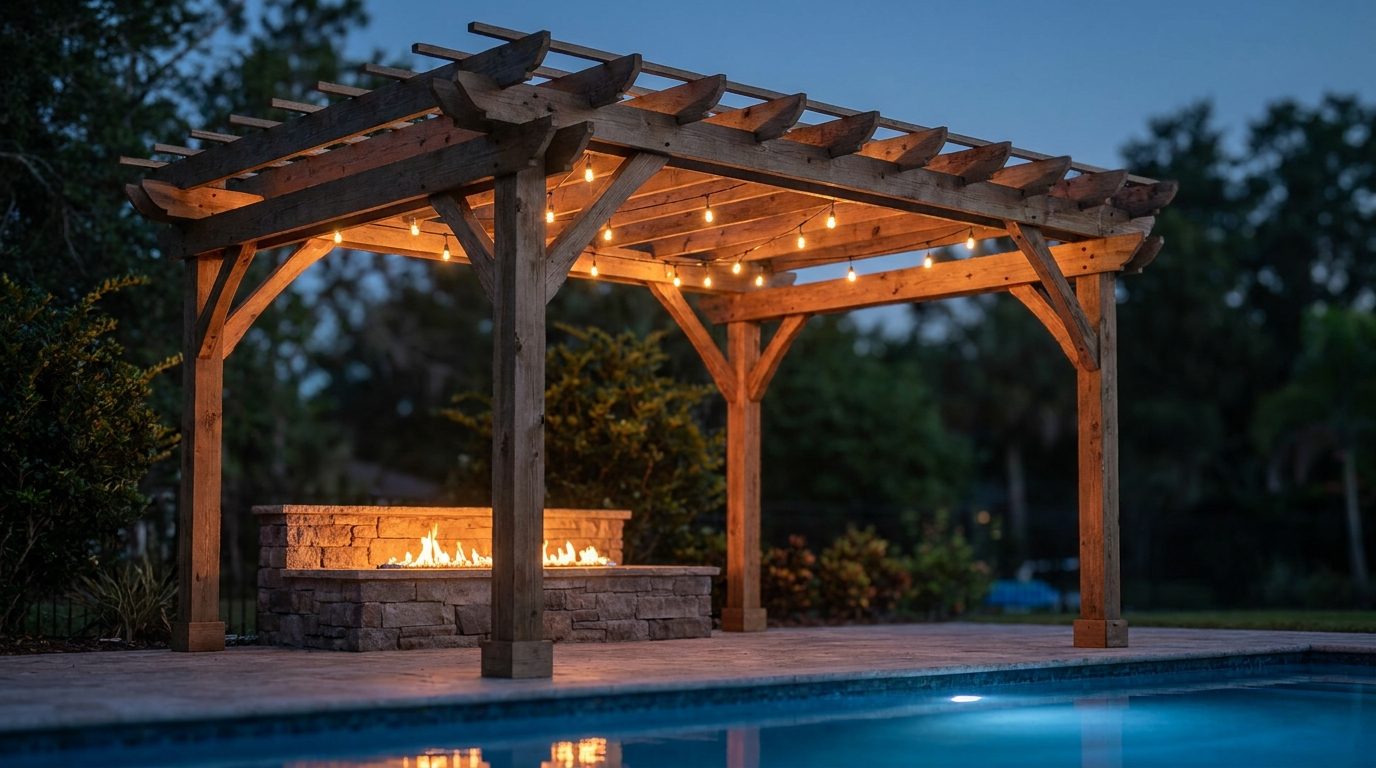
Walk any outdoor living builder's Instagram and you will see the same photo a hundred times: a finished pergola under a hard noon sky, shadows crushed to black, travertine bleached white, every lighting fixture the client paid for rendered invisible. It is an accurate photo. It is also a photo of the one moment nobody will ever use the space.
Homeowners do not buy an outdoor kitchen for lunch on a Tuesday. They buy the Friday dinner party. The fire pit conversation that runs past eleven. The pool glowing turquoise while the kids do one more cannonball. The whole category is an evening purchase, and the buying trigger is almost always a specific imagined night. If your video library only shows the space at high noon, you are marketing a product with the product turned off.
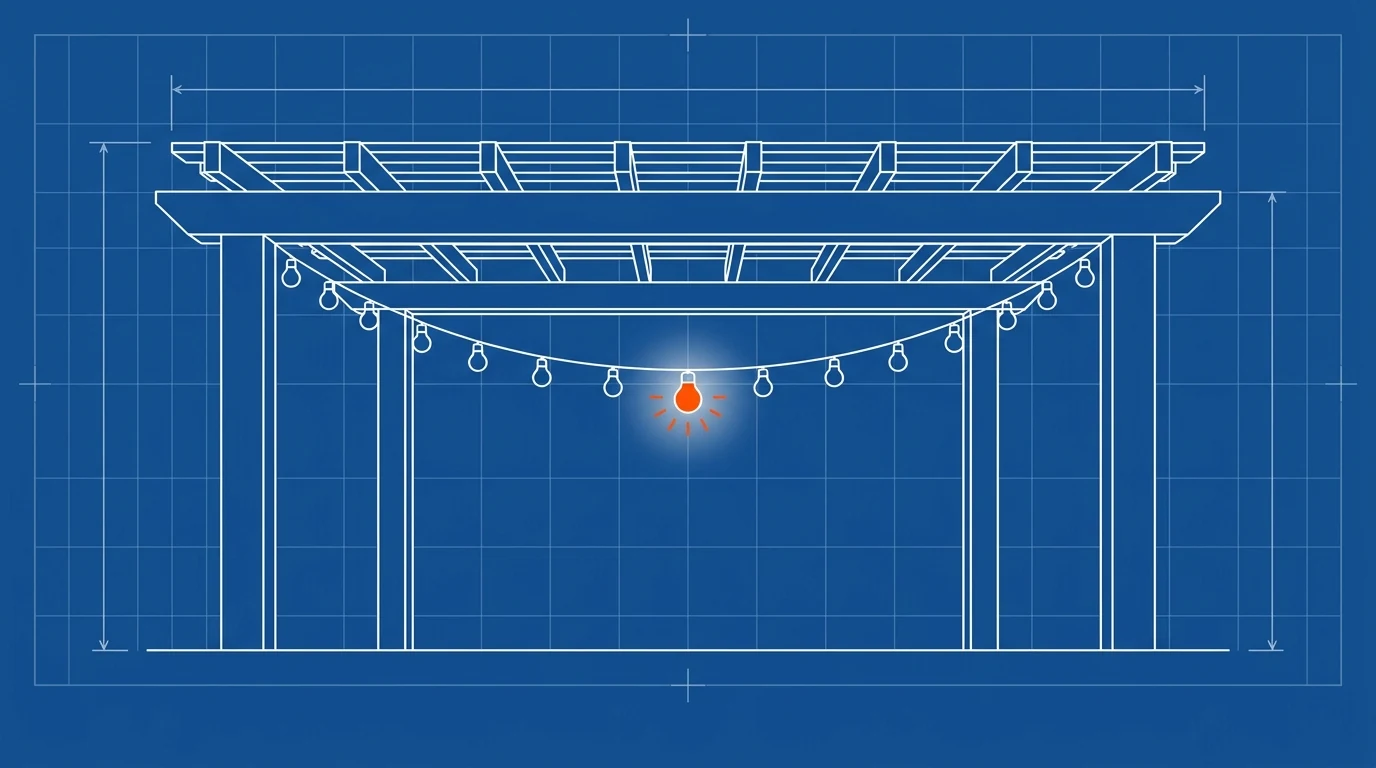
The product turns on at dusk
The product turns on at dusk · Illustration: Florida Construction Media
Think about what a premium outdoor living project actually consists of. A meaningful share of the contract value is invisible in daylight: the lighting design, the fire feature, the water feature with its underwater fixtures, the landscape uplighting, the audio. A $180,000 backyard and a $60,000 backyard can look surprisingly similar at noon. At 8:15 p.m., they look nothing alike.
That gap is your marketing opportunity, because ambiance is the thing prospects cannot get from a materials list. What separates a design-build outdoor firm from a hardscape crew is the composed evening — how the fire, the water, the light layers, and the sound work together. Video is the only medium that carries all of it at once. A photo shows the fixtures. Video shows the flicker, the ripple, the sound of the spillway. That is what the client is buying, so that is what you film.
The practical rule: daylight footage is documentation, twilight footage is the sales asset. Plan the shoot around dusk and treat everything before it as coverage.
The twenty-minute window
Twilight photography is a discipline, not an accident. The window where it works — sky still holding deep blue, artificial light warm enough to read as inviting, neither one blowing out the other — lasts roughly twenty minutes on a Florida evening. Show up at sunset and start figuring out your shot order and you will miss it. The sequence has to be planned like a pour.
The workflow that consistently works is day-to-dusk sequencing. Arrive ninety minutes before sunset. Shoot your wide establishing shots and detail passes in golden hour, when the light is directional and flattering but you are not yet racing the sky. As the sun drops, work from the brightest scenes to the darkest: golden-hour wides first, then the transition shots as fixtures come on, then the full blue-hour glamour shots, then the true-night fire and pool shots last, because fire and underwater light are the only subjects that still carry after the sky goes black.
Lighting circuits need to be staged before you roll: a walkthrough with whoever controls the system, confirming every zone works, every scene is programmed, and the fire feature has fuel. Nothing kills a twilight shoot faster than discovering at 8:05 that a transformer is tripped and half the uplights are dark. Turn everything on an hour early and fix problems while you still have daylight to fix them in.
Spec box: The twilight shot list, in shooting order. (1) Golden hour, sun still up: wide establishing shot of the full yard, slow push or lateral move; detail pass on materials — stone texture, cabinetry, pergola joinery. (2) Sun down, lights coming on: the "switch-on" moment itself, one static shot as string lights or a lighting scene activates; homeowner or crew walking the space. (3) Blue hour, the twenty minutes: hero wide of the whole composition with sky still deep blue; medium shots of the fire feature, the lit pool or spa, the outdoor kitchen under task lighting; a slow move along the string lights. (4) Full dark: close-ups of flame, water reflections, one final locked-off wide. Capture ten seconds minimum per shot, tripod or gimbal, and record the ambient audio — the spillway and the fire are part of the product.
Can a phone do this? Partly. Modern phones handle blue hour well, and a phone on a tripod in the twenty-minute window beats a mirrorless camera handheld at noon for selling this category. Where phones fall apart is full dark: night modes smear moving water and flame into mush, and small sensors turn pool light into noise. The fire close-ups, the water reflections, and anything with camera movement after dark justify real glass or a pro shooter. Use the phone for coverage and the switch-on moment; budget for professional capture on the hero project each quarter.
Florida sells evenings twelve months a year
Contractors in Ohio sell outdoor living against a calendar; Gulf Coast contractors sell against a lifestyle. The core Florida pitch is that the backyard is a room of the house that works in January. Your twilight footage is the proof. A February evening around a fire feature, in shirt sleeves, is the single most persuasive image this market has — it is the scene the northern buyer moved here to live in.
That points at two seasonal pushes. First, October through March, when snowbirds and new arrivals are physically here, sitting in unbuilt backyards, planning spring construction. This is when twilight reveal content should dominate your posting and your ad spend, because the audience is watching your February evening from their own bare lanai. Second, the spring shoulder, when the design-build pipeline for summer projects fills. The year-round-evening message never goes off-air; the volume just goes up when the planners arrive.
A content system per project
One twilight shoot is a post. A repeatable system per project is a marketing asset. Build each project's coverage as four pieces.
The design-intent clip. Sixty seconds, filmed at the design stage or day one, of the designer or owner explaining a decision a homeowner would never think to ask about: why the pergola faces west, why the fire feature sits away from the prevailing breeze, why the kitchen is positioned so the cook faces the pool. This clip does more to establish design-build credibility than any finished photo, because it demonstrates thinking, not just installation.
The build chapters. Short progress clips at the milestones — excavation, gas and electrical rough-in, hardscape, structure, fixtures. If the work happens in an occupied home's backyard, which it almost always does, your site discipline is itself content; the same protection-and-cleanup logic covered in our occupied-home playbook applies to a family whose kids want the pool back.
The twilight reveal. The shot list above, cut to 45 to 90 seconds, day-to-dusk. This is the asset the whole system exists to produce.
The first-evening testimonial. Do not interview clients in daylight at final walkthrough. Come back the first week, at dusk, lights on, and film them in the space at the hour they bought it for. The setting does half the interviewing. The mechanics — questions, release, capture — are the same system described in our client testimonial guide; the only change is the call time.
Sequenced together, these four pieces are the three-act project story applied outdoors: the problem and the intent, the build in the middle, and a reveal that happens to occur after sunset. The arc does not change. The lighting does.
There is also a post-close channel most builders leave on the table. Lighting scenes, seasonal programming, fire feature maintenance, pre-storm prep for pergola fabric and umbrellas — each one is a two-minute video sent to past clients. It costs almost nothing, keeps you in the phone of the person most likely to refer you, and positions the annual service visit as part of the product rather than an upsell.
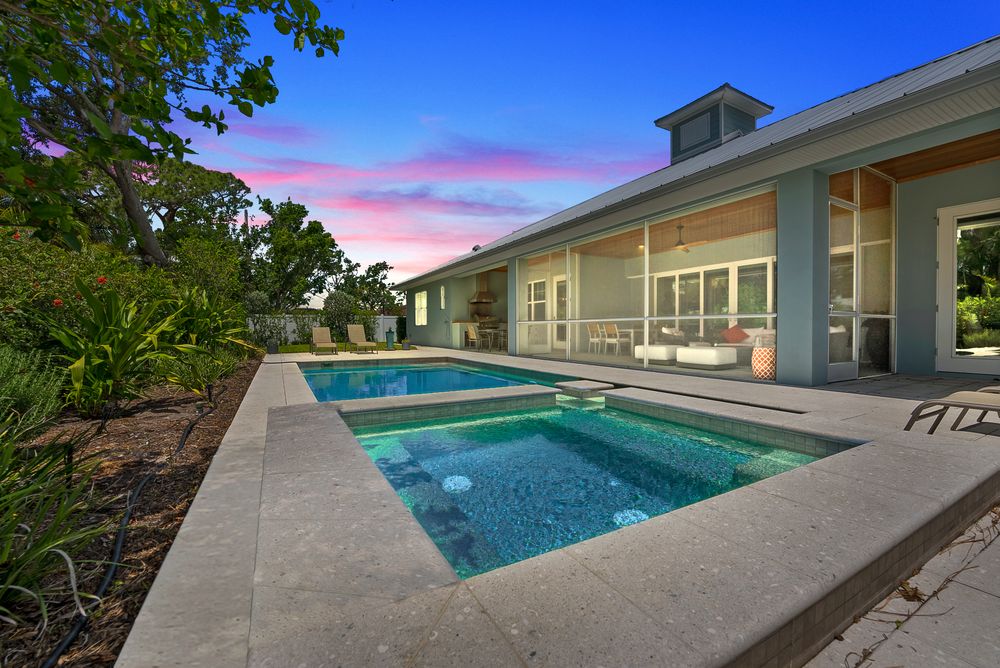
The after-dark after · Venice · Photo: Stellar Media Collective
Questions builders actually ask
Do I need the homeowner's permission to come back and film at night? Yes, and get it in writing before the contract closes, not after. Add a marketing-access clause covering one twilight shoot and one follow-up visit, with an opt-out. Most clients say yes when asked early and are irritated when asked late. Confirm dates, keep it to one visit, and leave the space exactly as found.
What if the project doesn't have much lighting in the contract? Then the twilight shoot is your case for adding it. Film the project at dusk anyway, honestly, and use the footage in design consultations to show prospects the difference between a lit and unlit version of the same budget tier. Several builders find the reveal footage sells lighting packages on the next project better than any brochure line item.
Is twilight content worth it for smaller jobs, or only showcase projects? Run the full four-piece system on your top two or three projects a year and a reveal-only version on the rest. A modest paver-and-pergola job still photographs dramatically better at blue hour than at noon, and the twenty-minute shoot costs you one evening. Reserve professional capture for the showcase tier; shoot the rest on a phone and tripod using the same shot order.
Published July 6, 2026. Florida Construction Media is produced by Stellar Media Collective, a video production and marketing firm in Sarasota that works with builders and premium trade contractors across the Gulf Coast.