Why Publishing Your Prices Filters Better Clients — the Math and the Psychology
The blank price page feels safe. It's the most expensive real estate on your website — paid for in wasted consults, and in the good clients who never call.
8 min read · July 8, 2026 · Florida Construction Media

Every builder who refuses to put a number on the website gives the same reason: our work is custom, so we can't publish a price. It's true, and it's also not the real reason. The real reason is fear — that a number scares people off, that a competitor undercuts it, that a stranger anchors on the low end of a job you'd never build. So the website says "contact us for a quote," the phone rings with people who have no idea what a real project costs, and the owner spends his evenings driving to consults that were never going to close.
The blank price page feels like the safe choice. It is quietly one of the most expensive decisions a premium trade makes. Here is the arithmetic on what it costs, and the psychology of why a number on the page pulls in better clients than the silence does.
The cost of the blank price page
Start with the most expensive resource in the business: the owner's time on a site visit. A serious consultation for a six-figure remodel is not a phone call. It's a drive, an hour walking the space, measurements, a follow-up proposal, and the mental load of holding the job in your head for a week. Call it three to four hours of owner time, fully loaded, per real consult — and owner time is the one input you cannot subcontract.
Now run two builders side by side. Both generate ten inquiries a month.
Builder A publishes nothing. All ten inquiries feel obligated to book a consult to learn anything at all, so ten consults get scheduled. Six of them are people who were stunned to hear the kitchen starts at $90,000 — they wanted $30,000 and a blank page let them believe that was the conversation. Four are real. The close rate on ten consults is those same four qualified people; the other six were forty-plus hours of owner time spent teaching strangers what a project costs.
Builder B publishes a starting range and a short guide to what drives it. Of the same ten inquiries, five self-select out before they ever call — they read the number, did the math, and decided this wasn't their year. That is not lost business. Those five were never going to sign; they were going to consume a consult and say they'd "think about it." Five qualified people book. Four close. Same four jobs, half the windshield time, and a close rate that now reads 80 percent instead of 40 — which matters, because the owner spends the reclaimed twenty hours a month either selling to people who can buy or building for the ones who did.
The price page doesn't cost you jobs. It costs you the consults you should never have driven to. What it protects is the scarcest thing you own.

A published number does the first round of qualifying before you ever get in the truck · Illustration: Florida Construction Media
What a number does to the reader
The math is only half of it. The other half is what happens in the head of the person reading your website at 10 p.m., comparing you to two other builders.
A number reads as confidence. A trade that will state where its work begins is telling the reader it isn't afraid of the comparison — that it knows what it's worth and expects to be judged on value, not on being the cheapest bid. Silence reads as the opposite, whether you mean it to or not. The buyer's private translation of "contact us for pricing" is if they won't say, it's because it's high and they want to talk me into it first. You wanted to seem flexible. You seemed evasive.
There's research behind this that isn't specific to construction but travels straight into it. In a Harvard Business School field study, Lifting the Veil: The Benefits of Cost Transparency, diners were 21 percent more likely to buy when a product's price was shown alongside an honest breakdown of what it cost the seller to make it — even when that made the margin visible. Voluntarily showing the number, the researchers argued, signals that the seller has nothing to hide, and trust rises accordingly. A homeowner vetting a $250,000 remodeler is running the same instinct on a much larger number.
The buying behavior has already moved to meet this. Most buyers now do the bulk of their research before they ever talk to a person, and a large share actively prefer a self-directed, rep-free path until they're ready to commit. In home services specifically, unclear pricing sits near the top of what frustrates customers most. The client wants to qualify themselves in private, on their own timeline, before they raise their hand. A number lets them. A blank page forces a phone call as the price of admission — and the best clients, the busy ones with the budget, are the least willing to pay a phone call to find out if you're even in their range.
And a number anchors quality. A remodeler whose website says projects begin at $150,000 has, in one line, told the reader what tier of work this is and screened out the entire tire-kicker economy. Price is the fastest signal of position you have. Refusing to send it doesn't make you look premium. It makes you look unsure.
You don't have to publish one number
The custom-work objection is real, and the answer isn't to invent a fake fixed price. It's to publish enough of a number that the reader can qualify themselves — which is a lower bar than most builders think.
A starting figure does almost all the work: "Kitchen remodels begin at $85,000; most of our projects land between $120,000 and $250,000." That single sentence sorts your entire inbound list without committing you to anything. A price guide does even more — a short, honest walkthrough of the four or five things that move a number, the kind of resource that both filters and educates. (We built the case for that asset in the cost-guide funnel, and itemized real Florida ranges in what professional video actually costs — the same logic applies to any premium trade.) Best of all is a short video of the owner explaining, in plain language, why the work costs what it costs — the same conversation you'd have on the tenth consult, delivered once, to everyone, before they call.
Rule of thumb: you don't have to publish the price of the job. You have to publish enough of a number that the wrong client disqualifies themselves in private and the right client arrives already knowing they can afford you. A starting figure, a range, and one honest paragraph on what moves it clears that bar.
The objection worth taking seriously
One concern survives the scrutiny: a competitor sees your starting number and quotes just under it. This happens. It matters far less than it feels like it should. A builder who wins by being $8,000 cheaper than your published start is competing for the client you didn't want — the one for whom price is the whole decision. That's the client most likely to churn, dispute, and never refer, and you just handed him to a competitor for free. Let them fight over the bottom of the market.
The client worth protecting isn't choosing on price; they're choosing on trust, proof, and the feeling that you understand the outcome they're buying — a feeling you build with the content most of your market consumes long before they're ready to sign. Sell certainty and fit, not a discount, and the number stops being a vulnerability. It becomes the first thing that separates your buyer from everyone else's.
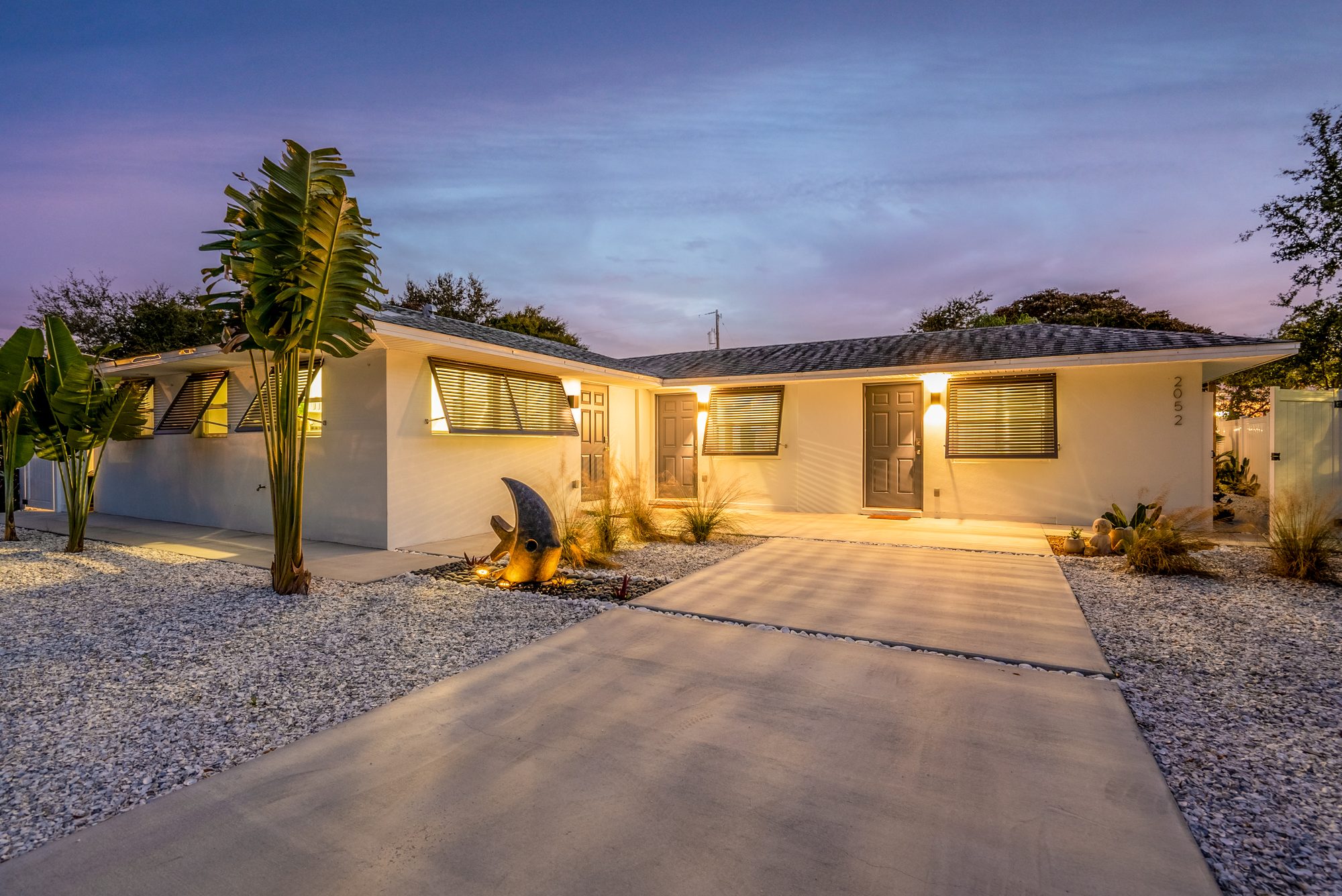
The tier the number is meant to signal · Sarasota · Photo: Stellar Media Collective
Questions builders actually ask
Won't a high starting price scare off people who might have afforded it after we talked? A few, yes. But that's the trade you're choosing: a handful of maybes who needed convincing, in exchange for not spending forty hours a month on consults that end in sticker shock. The people a real number scares off are, overwhelmingly, the people it was supposed to scare off. The genuinely qualified buyer reads "starting at $150,000," thinks good, they're in my range, and calls with less hesitation, not more.
Our jobs really do range from $40,000 to $600,000. What number do we even show? Show the floor and the middle: "Projects begin at $40,000; most land between $120,000 and $250,000." The floor stops the sub-$40K inquiries cold. The typical range tells a $200K client they're squarely your kind of work. You're not pricing the job on the website — you're drawing the map of who belongs on the call.
Should the number go on the site, or do we save it for the consult so we can sell first? Saving it for the consult is exactly the move that fills your calendar with unqualified consults. The modern buyer researches in private and resents being made to book a call to learn a basic fact. Put a starting range where they'll find it, and let the consult be for the people who already cleared the bar. The consult is worth infinitely more when everyone in it can afford you.
What about publishing our actual proposals or a full price list? You don't need to, and for genuinely custom work you shouldn't — a full menu invites line-item haggling on scopes that aren't comparable. A starting figure, a typical range, and an honest explanation of the three or four drivers is the sweet spot: enough for the reader to qualify themselves, not so much that you've turned a bespoke build into a commodity spec sheet.
Published July 8, 2026. Figures in the consult example are illustrative arithmetic, not survey data; the cited research on cost transparency and buyer behavior is linked inline. Florida Construction Media is produced by Stellar Media Collective, a video marketing studio in Sarasota that works with builders and premium trades.