Canadian Lumber Tariffs in 2026: The 34.75 Percent Stack and How to Quote a Florida Frame This Winter
Commerce cut the duties on most Canadian softwood in October, but the 10 percent Section 232 tariff still sits on top, and the cabinet tariff is set to double on January 1, 2027. What the stack adds up to, why the market moved more than the duty did, and the quoting rule that keeps a Gulf Coast frame from eating your margin.
7 min read · October 30, 2026 · Florida Construction Media
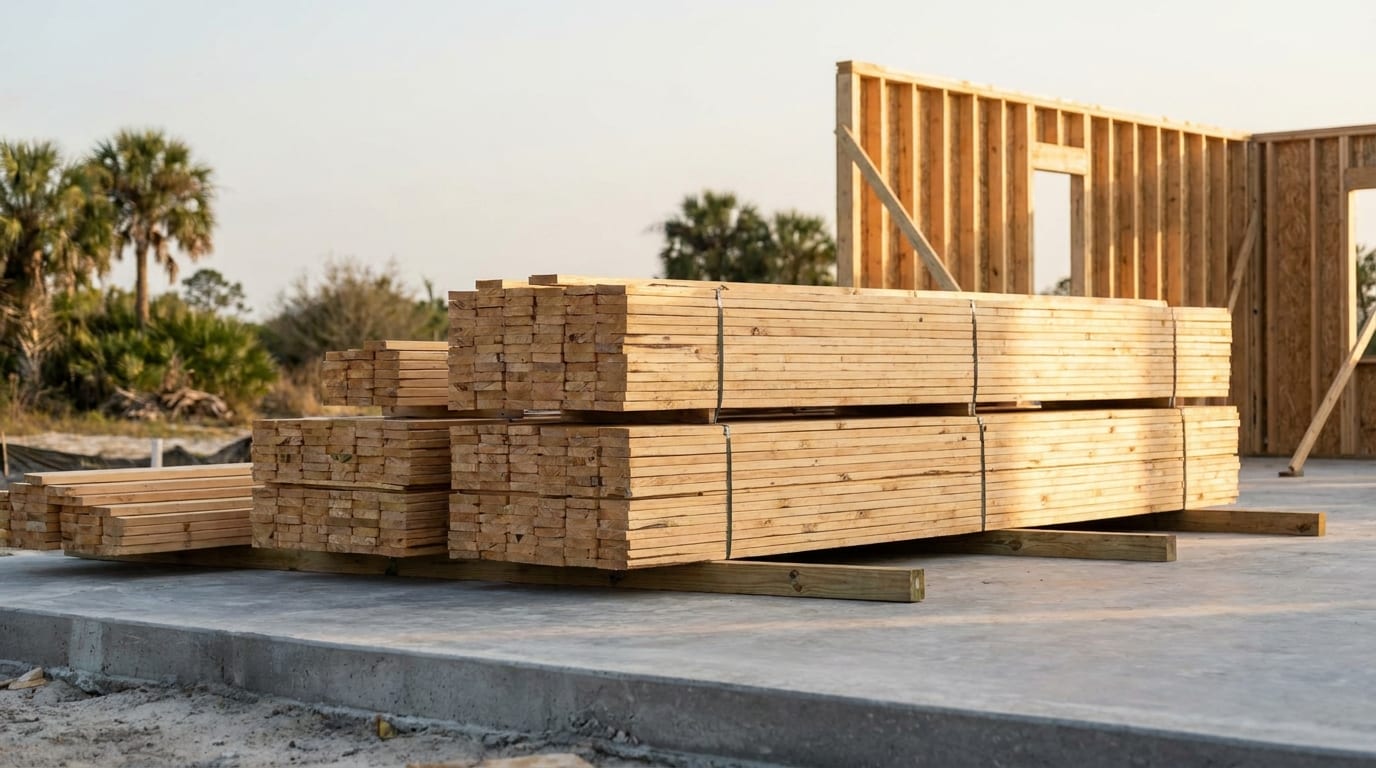
A year ago the lumber conversation on every Gulf Coast job was about tariffs stacking up. This month one layer came off. In mid-October the Commerce Department finished its seventh review of the duties on Canadian softwood and set the combined antidumping and countervailing rate for most mills at 24.75 percent, down from 35.16 percent, according to The Canadian Wire. That is the good news. The rest of the stack did not move, and one piece of it is scheduled to get heavier in nine weeks.
This is the read for the people who price frames and finish packages: what the stack adds up to now, how much of a real house it touches, and how to write a quote this winter that does not bet your margin on a number Washington can change.
The stack, layer by layer
There are three separate tariffs in play, set under three separate laws, and they do not move together.
The softwood duties: 24.75 percent. The final rate is 10.64 percent antidumping plus 14.11 percent countervailing for the mills that were not individually reviewed, per The Canadian Wire. The review covers lumber shipped in 2024, and the new rates take effect when Commerce publishes the final results in the Federal Register. An eighth review, covering 2025 shipments, began on March 9, 2026, so this number will be reset again.
The Section 232 lumber tariff: 10 percent. Since October 14, 2025, imported timber and lumber has carried a 10 percent national-security tariff on top of the duties, as the Florida Building Material Association laid out when it took effect. The October review did not touch it. Add it to the new duty rate and the all-in charge on most Canadian softwood is 34.75 percent, as Wood Central reports, down from about 45 percent before the review, per The Canadian Wire.
The Section 232 cabinet and vanity tariff: 25 percent, going to 50. Imported kitchen cabinets and bathroom vanities have carried a 25 percent tariff since a September 2025 proclamation. The step up to 50 percent was supposed to land on January 1, 2026. A December 31 proclamation pushed it to January 1, 2027, according to Thompson Hine, and the increase does not apply to countries that reach a deal with the United States on wood products. If you read last fall that cabinets went to 50 percent this year, that schedule changed.
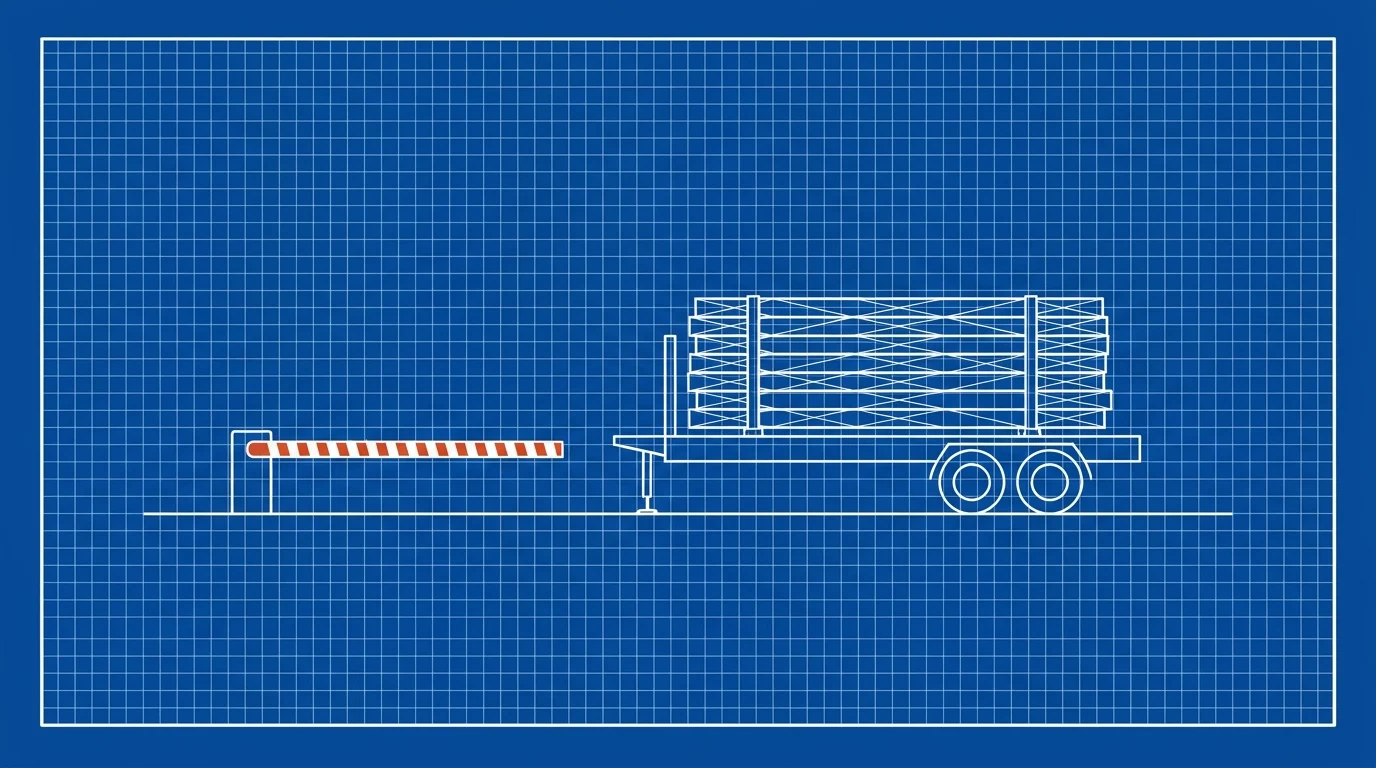
Every load crosses the same gate; only the toll changes · Illustration: Florida Construction Media
Why the market moved more than the duty did
Here is the part that matters for a quote. The duty cut is worth roughly ten points on Canadian wood. The market has moved far more than that on its own.
Lumber futures settled at $507.50 per thousand board feet on October 27, a 2026 low, down from $539.50 at the end of September and from a peak of $695.50 in August 2025, per Wood Central. The cash side tells the same story. The Madison framing lumber index was $494.51 per thousand board feet on October 23, down 3.4 percent from a year earlier, according to NAHB's framing lumber page, and Trading Economics had the benchmark near $513 on October 30.
Read those numbers together and the lesson is plain: lumber fell about 27 percent from its 2025 peak while the tariff stack was rising. Weak demand did that, not trade policy. Builders who priced last summer's quotes off the tariff headlines overestimated; builders who priced off the yard's sheet were closer. The same will be true going the other way. If spring starts pick up (we covered the September starts numbers here), lumber can climb faster than any duty review moves it down.
The math on one Florida frame
Assumptions: One house uses about 15,000 board feet of framing lumber, the rule of thumb NAHB uses. Assume the Madison cash price of $494.51 per thousand board feet. Assume a third of the package is Canadian; Florida draws nearly a third of its softwood from imports, per FBMA, and your yard's mix may be higher or lower. Assume the full duty change passes through to price, which overstates it, since duty is charged on the mill's export value, not the delivered price. Yard markup, delivery, sheathing, trusses and engineered lumber are left out.
For example: 15 thousand board feet at $494.51 is about $7,400 of framing lumber at the index. A third of that, about $2,470, is the Canadian share. A 10.41-point drop in duty on that share is worth at most about $260 on the house.
Now run the market instead. The same 15,000 board feet at the August 2025 futures peak of $695.50 would have been about $10,430. At the October low of $507.50 it is about $7,610. That is a swing of roughly $2,800 on one frame, more than ten times the duty cut.
So the duty cut is real, it is welcome, and it is a rounding error next to the market. Do not hand it to a client as a discount, and do not build a quote that assumes it stays.
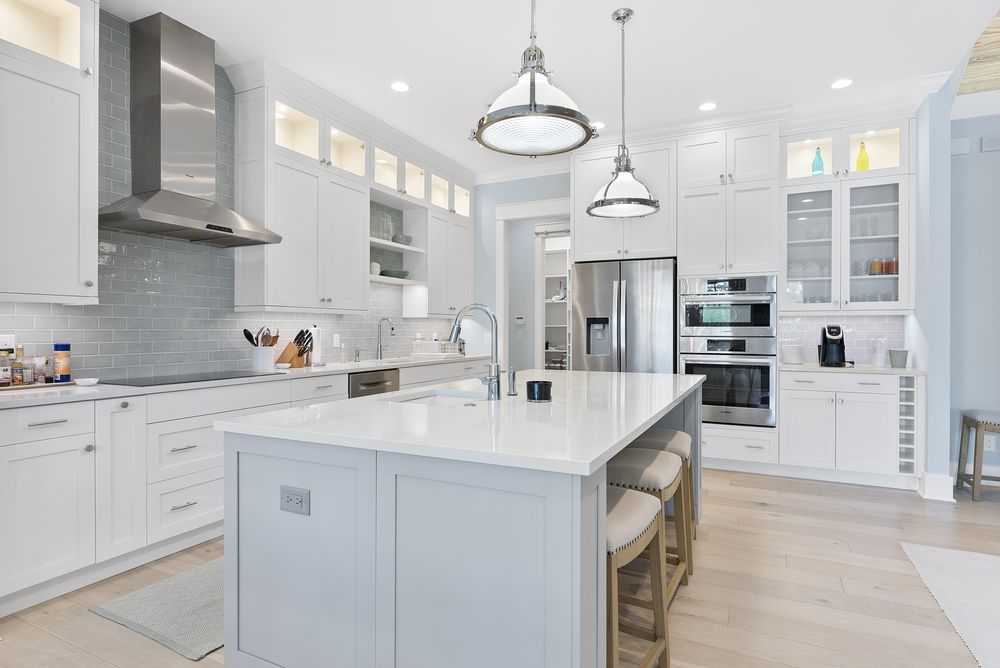
Where the next tariff lands: cabinets and vanities ordered for 2027 installs · Kitchen build-out, Venice · Photo: Stellar Media Collective
The play: how to quote a frame and a finish package this winter
Tie lumber to a public index, in writing. Name the index (Madison, Random Lengths, or your yard's published sheet), the date you priced it, and a band. Inside the band, you eat it or keep it. Outside, the contract adjusts both ways. The clause that moves down as well as up is the one a premium client signs without a fight, because it reads as fairness, not a hedge. It is the same logic as the risk-reversal menu: take the uncertainty off the table and name who carries it.
Lock the package at contract, not at permit. On the Gulf Coast the gap between a signed contract and a framing delivery can run months, longer now that permit counters are busy ahead of the new code date. Price the frame the week you can order it, and say so.
Split cabinets out of the finish allowance. For any remodel or custom home whose cabinets and vanities will be ordered after January 1, 2027, ask your supplier where the boxes come from. Imported casework could carry double today's tariff on that date. Domestic shops and countries with a wood-products deal will not. Put the cabinet line in its own allowance with an order-by date, so the client sees the deadline and makes the choice.
Hold quotes for 30 days, not 90. A lumber market that dropped six percent in a month can rise six percent in a month. Short quote windows are normal in this market and nobody serious reads them as pressure.
Explain it once, on camera, and reuse it. Every client this winter will ask why the frame number has a clause in it. A two-minute short video of you at the slab walking through the index, the band and the cabinet date answers it before the consult and saves the same ten minutes at every estimate table. That is the kind of explainer a Sarasota studio like Stellar Media Collective builds into a builder's library; you can just as well shoot it on a phone. What matters is that the client hears it from you first.
Questions builders actually ask
Did the lumber tariff go down? Part of it did. The antidumping and countervailing duties on most Canadian mills fell to 24.75 percent from 35.16 percent in the October review. The separate 10 percent Section 232 tariff did not change, so the all-in rate is about 34.75 percent.
When do the new duty rates start? When Commerce publishes the final results in the Federal Register. Some trade coverage gave an October date; the Canadian Wire report ties it to publication. Either way, yard prices will not reprice overnight, because most lumber on the lot was bought before the change.
Are cabinets at 50 percent now? No. Imported kitchen cabinets and vanities stay at 25 percent through 2026, and the increase to 50 percent is set for January 1, 2027, per the Thompson Hine summary of the December proclamation.
Should I lower my framing price because of the cut? Price off your yard's current sheet and an index clause, not off the duty headline. The cut is worth a few hundred dollars on a house at most under the assumptions above, and the market swings by thousands.
Will the duties change again? Yes. The eighth review, covering lumber shipped in 2025, is already under way, and the rate it lands on could be higher or lower. That is the case for an index clause instead of a guess.
Tariff rates, lumber prices and dates checked October 30, 2026. Disclosure: Florida Construction Media is owned by Stellar Media Collective. Nothing here is legal or trade-compliance advice; confirm current rates with your supplier before you sign.