Developer-Facing Portfolios: How Subs Win Multifamily Bids With Video
Homeowners buy your taste; construction managers buy down risk. Here is the three-minute capability reel that answers a CM's checklist — and what to film on every commercial job so you never have to build it from scratch.
8 min read · July 6, 2026 · Florida Construction Media

The reel that wins you a $90,000 lanai dies quietly in front of a construction manager staffing a 300-unit delivery. Not because the work is worse — because the question changed. A homeowner hires on trust and taste: will these people respect my house, will I love what they leave behind. A developer or GC hires on risk: can this sub staff the package, hold the schedule, keep the site clean, and finish without generating claims. Beautiful barely registers. Everyone who made the bid list has beautiful.
Most subs point homeowner marketing at commercial buyers anyway, because it's the marketing they have. What follows is the correction: what a developer-facing reel actually contains, minute by minute — and what to film on every commercial job so the thing assembles itself out of work you already did.
What a construction manager is actually vetting
Pre-qualification is a risk instrument. Somewhere in the developer's or GC's office is a checklist, formal or not, and every line on it is a way a sub has burned them before: capacity — can you field the crew, and still field it in month seven; mobilization — do you show up on the date with material and a plan, or with two guys and a promise; schedule reliability across a whole package rather than one lucky week; safety practices that won't drag their insurance into your problem; housekeeping that doesn't tax every other trade on the floor; and communication that survives a bad week.
A homeowner reel is an emotional document. A developer reel is an evidentiary one. Its job is to put footage against the lines of that checklist, which is why it's built like a bid package, not a brand video. The walkthrough that sells a remodel runs on the same footage discipline; the argument is entirely different.

The bid package that moves · Illustration: Florida Construction Media
The three-minute capability reel, minute by minute
Three minutes, because that is roughly what a CM will give an unfamiliar sub between two other fires. The structure is fixed; the footage is yours.
0:00–1:00 — Scale and mobilization. Open with your name, your trade, and the biggest true thing you can show. Crew scale goes on screen, not in a caption: thirty hard hats on a deck pour, the yard full of lettered trucks at 6:40 a.m. Then mobilization — equipment rolling in, material landing by building, first-day layout underway. Capacity is the first pre-qual question, and the first minute answers it visually or the reel has already failed.
1:00–2:00 — How the work runs. Process, shown rather than narrated. PPE on every head without a caption pointing at it. A toolbox talk actually happening. Housekeeping in the frame: cords coiled, scrap in the dumpster instead of the corridor, material staged by floor, work zones taped off. This is the claims-avoidance minute. A CM who has managed a sloppy sub can read a clean one in ten seconds of b-roll; no narrator can talk them out of what the footage shows.
2:00–3:00 — Schedule proof, then the walk. Milestone dates hit across one package, with the dates visible — the schedule wall, the milestone board, footage stamped by phase from start to turnover. Then close on the completed-community walk: corridors, finished units, the amenity center, the work at full scale. Last shot is the owner, one line, to camera — who you are and what packages you take. Skip the ten-job montage; one package traced end to end beats ten proved nowhere.
Bank the library on every commercial job
Nobody shoots that reel in a weekend, and trying is how it comes out looking staged. The credible version is banked across jobs and months, which makes the real discipline capture, not production. Every commercial job you're on is already generating the proof; the only question is whether anyone records it.
| Proof point | The shot | Why a CM cares |
|---|---|---|
| Crew capacity | Wide shot on your peak-crew day, heads countable | Capacity is the most inflated claim in every pre-qual; footage isn't arguable |
| Mobilization | Trucks arriving, material landing, first-day layout | Late mobilization is how schedules die; arriving like a company reads on camera |
| Safety culture | Toolbox talk mid-session, PPE worn unprompted, taped zones | Claims and stop-work orders are their exposure, not just yours |
| Housekeeping | End-of-shift sweep-down, staged material, clear corridors | A dirty sub taxes every trade behind it; clean reads as managed |
| Schedule performance | Site sign, schedule wall, dated footage at each milestone | Dated footage across a package is proof no reference call can match |
| Finish at scale | The completed-community walk: units, corridors, amenities | Answers the question under all the others — you have finished this before |
Spec box: The commercial-job banking checklist.
- Write filming permission into the subcontract at signing; a verbal okay in month three isn't one.
- Name one person per job to own capture: day one, peak-crew day, every milestone, last day.
- Shoot 16:9 horizontal, always; verticals get derived in the edit, never on site.
- Get dates on camera — site sign, schedule board, milestone wall. Dated footage becomes schedule proof later.
- File it the day it's shot, by project, building, phase, and date. Footage nobody can find doesn't exist.
Progress documentation: a line item, not a favor
On multifamily and commercial work, somebody is already paying for progress documentation, because lenders and equity partners require visual verification of what the draw schedule bought. The sub or GC who delivers monthly drone documentation — same flight path every month, fixed vantage points so month four compares cleanly to month three, dated stills plus a short cut for the lender deck — earns a fee and walks away owning the footage library that wins the next bid. You are being paid to build your own bid package. On active sites that means a Part 107 certificated pilot with aviation-aware insurance; the rules are stricter than most operators assume. The delivery wave we covered in the Gulf Coast apartment briefing is the reason to stand this up now: a decade-high volume of vertical construction within an hour's drive, all of it reporting monthly to somebody with money in the deal.
The clip that does the pre-qual meeting's work
Separate from the reel, film the owner answering the hard questions — one question per clip, sixty to ninety seconds, plain answers with real numbers. "How do you staff a 200-unit flooring package?" is the archetype, and the answer that works is boring on purpose: how many crews, who leads them, the bench behind them, and what happens when a lead installer quits in week six. Then the rest of the list: what QC looks like at unit 180 when everyone is tired, how a three-week compression gets absorbed, what your submittal turnaround actually runs. No adjectives, no music swell. A CM watching one of these is auditioning the person they'll be calling when something goes sideways, and grading the answers on specificity. If the owner locks up on camera, the fix is the same script discipline that works for homeowner videos; only the questions change.
Send it where bids are decided
None of this is social content, and treating it that way wastes it. The developer reel works in four places. The bid package: a plain link on the first page of the capability statement — one click, no login, loads on a job-trailer connection. The pre-qual email: the follow-up that carries proof instead of "just checking in." LinkedIn: the one feed where CMs, developers, and owner's reps exist in a professional capacity, and where a sub posting dated milestone footage is conspicuously rare. And the trailer meeting: the reel on a laptop in the sixty seconds before the meeting starts outworks the same file posted anywhere, because everyone who matters is already in the room.
Give it a permanent address — a /commercial page holding the reel, the owner clips, and the capability statement PDF — so the link in every bid package is the same link, and it never breaks mid-pursuit.
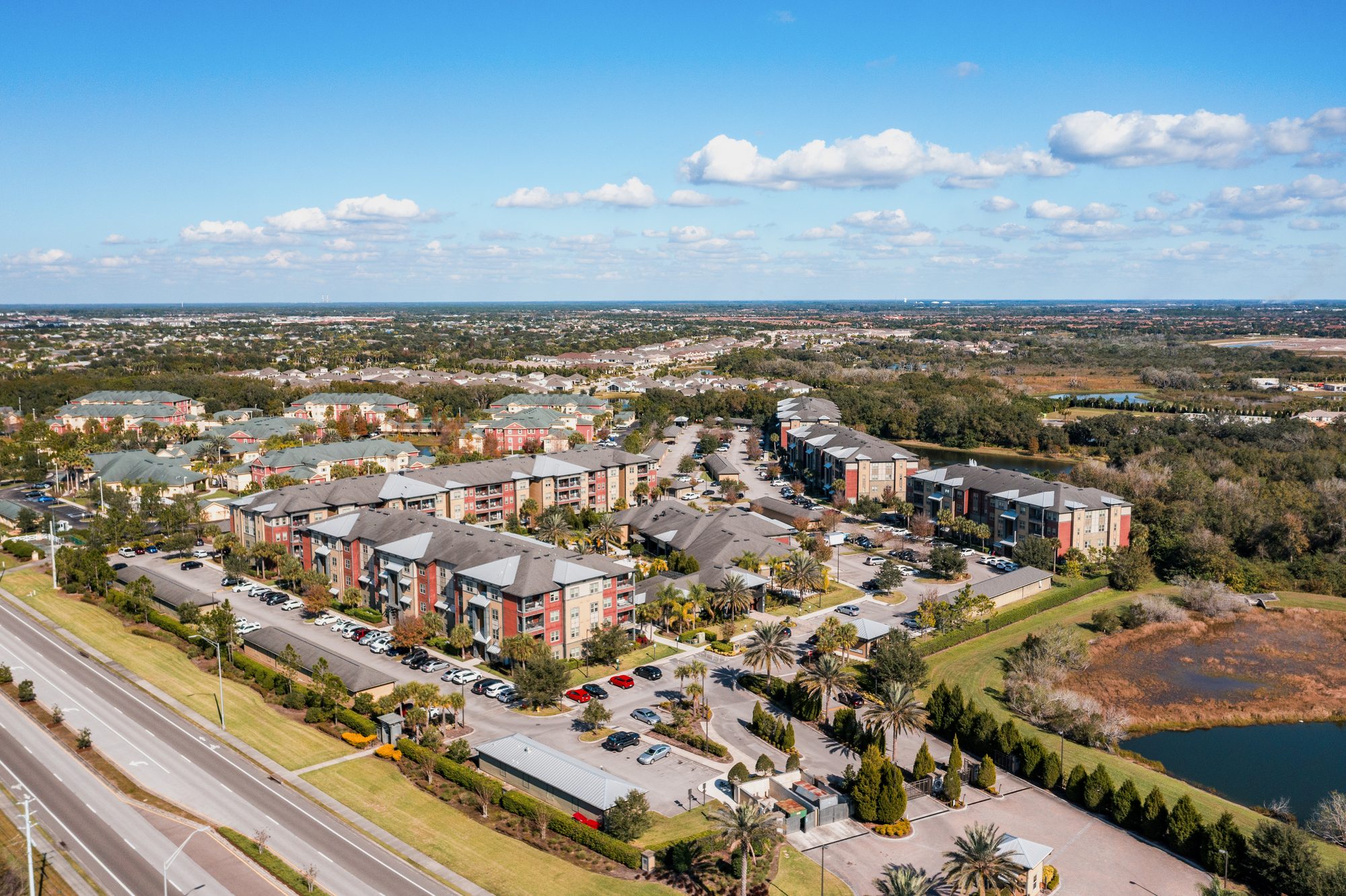
The client behind the client · Bradenton · Photo: Stellar Media Collective
Questions builders actually ask
We're a 12-man shop; does this scale down? It scales down to whatever you can show truthfully, which is the point. A 12-man shop bidding 40-unit interior packages doesn't need thirty hats on a pour; it needs its own evidence at its own scale — the full crew working one floor, mobilization that looks like a company, dated milestones across one completed package. CMs spend careers smelling overextension. The shop that shows exactly what it can staff gets called for work it can actually do, which was the goal.
Do we need permission to film on a GC's site? Yes, written, and the time to ask is at subcontract signing, not month three. Expect conditions: your scope only, no other trades' defects, nothing the developer hasn't publicly released, and whoever films follows site safety like anyone else. Most GCs agree, especially if you share the footage — their marketing coordinator has the same empty library you do.
What does the reel itself cost? It depends where the footage comes from. With a banked library, you're buying an interview setup and an edit — the bottom of the produced-video range. If a crew has to mobilize to three active sites to capture what nobody filmed, you're at the top of it. The banking checklist above is the entire difference between those two numbers, which is the argument for starting it on the next job instead of the next bid.
Published July 6, 2026; practices and market notes are current as of that date. Disclosure: this publication is owned by Stellar Media Collective, a Sarasota studio that produces capability reels and progress documentation like the work described — the playbook holds whether or not you hire one.