FEMA's 50% Rule and Coastal Remodels: What to Communicate on Camera
One threshold decides whether a Gulf Coast project is a kitchen remodel or a whole-house elevation. Most homeowners first hear about it from a stranger at the permit counter. Here is how to explain it on camera — accurately, and without pretending you're the one who makes the call.
8 min read · August 15, 2026 · Florida Construction Media
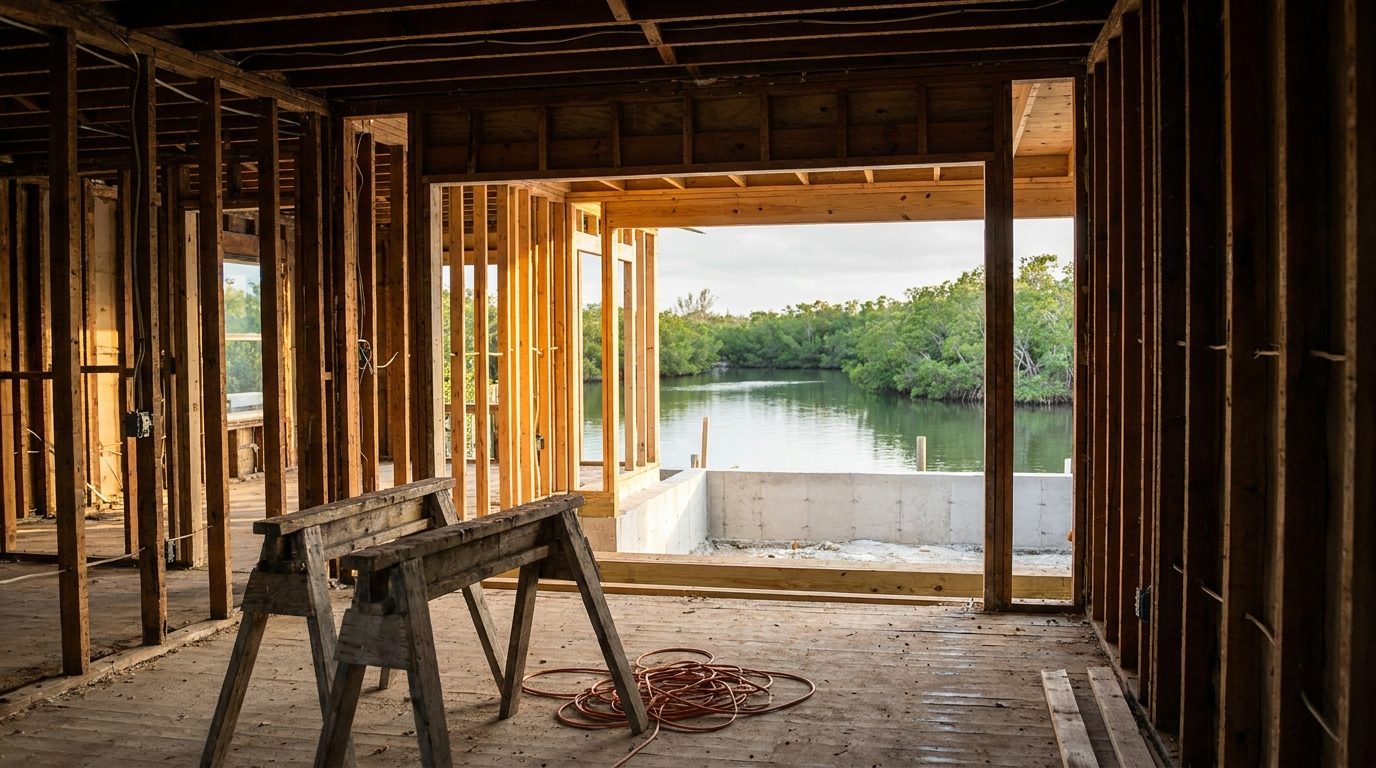
A homeowner calls about a kitchen and two baths on a canal lot in Nokomis. Nice house, 1968, slab on grade, three feet of water in it during Helene, since dried and patched. They have a number in their head — call it $180,000 — and a Pinterest board. Somewhere in the first twenty minutes of that conversation, an honest builder has to introduce a threshold they have probably never heard of, and explain that it may turn their remodel into a different project entirely.
This is the most consequential piece of information in a Gulf Coast remodel conversation, and it is almost always delivered badly: late, secondhand, at a permit counter, by someone with no stake in the client's project. The builders winning this work explain it first, in their own content, carefully — and are unmistakably clear that they are not the ones who decide.
What the rule actually says
Under the National Flood Insurance Program, substantial improvement means any reconstruction, rehabilitation, addition, or other improvement of a structure where the cost of the work equals or exceeds 50 percent of the market value of the structure before the work starts. Substantial damage means damage of any origin where the cost of restoring the building to its before-damaged condition would equal or exceed 50 percent of the market value before the damage occurred. FEMA publishes both definitions and the full compliance framework in its Substantial Improvement/Substantial Damage Desk Reference.
Cross either line and the outcome is the same: the building is no longer allowed to stay non-conforming. It has to be brought into compliance with the current flood requirements — for a house in a Special Flood Hazard Area, that generally means the lowest floor at or above base flood elevation, plus whatever freeboard the local ordinance adds on top.
Three things get lost in the retelling, and all three belong on camera.
Market value means the structure, not the land. On a waterfront lot where the dirt carries most of the value, this is the whole ballgame. The house is the denominator, and the house is often the smaller number.
The local floodplain administrator makes the determination. Not FEMA, not the insurance adjuster, not the contractor. The NFIP-participating community enforces the ordinance, and the county or municipal building department is where the ruling lives.
Fifty percent is a federal floor, not a ceiling. Communities may adopt stricter standards, and several here have — which is why two neighbors on opposite sides of a city line can get different answers.

Cost of work on one side, value of the structure on the other — the whole rule in one picture · Illustration: Florida Construction Media
The four places the number moves
The rule is uniform. The arithmetic is not. Four variables decide where a given project lands, and every one of them is jurisdiction-specific.
How market value gets set. Manatee County takes values from the Property Appraiser's site and backs out land and site features — fences, detached structures — to isolate the building, while allowing owners to challenge that figure with a private appraisal carrying a pre-storm effective date and photographs of pre-damage condition. Charlotte County likewise excludes land and other on-parcel improvements, and accepts either a qualified independent appraisal or an adjusted tax-assessment value. Same federal definition, two different starting numbers, and the gap between an assessment and a real appraisal can be the whole margin.
What counts as cost. More than the client is writing checks for. The cost side generally includes materials at market value, labor — including the owner's own and any work donated or discounted — demolition, and overhead and profit. Certain soft costs may be excluded. May is carrying real weight there; the exclusions are set locally, and guessing at them is how a project gets re-scoped after permit.
Whether costs accumulate. Manatee's ordinance language is explicit that the qualifying work is measured across a one-year period, cumulatively. Sarasota County addresses the same behavior under the heading of phasing: splitting one improvement across several permits does not split the calculation, and if the permits sum past the threshold, the structure is substantially improved. Ask what window applies before you sequence a job across permits — not after.
What documentation is required. Charlotte County wants a detailed cost breakdown with a signed affidavit from an architect, engineer, contractor, or owner, plus photographs when the owner signs it. That paperwork is the record the determination gets made from, and a sloppy line-item estimate is the most common reason a decision takes weeks instead of days.
What belongs in the cost breakdown you hand the floodplain office: every trade line at market value, including work the owner intends to self-perform; demolition and debris removal; overhead and profit; owner-supplied materials; and the market-value figure you're measuring against, with its source. Anything left off is a line the reviewer has to add back — and they will.
There is money on the other side of the determination worth naming. Policyholders whose buildings are declared substantially damaged can claim Increased Cost of Compliance coverage of up to $30,000 under a standard NFIP policy, usable for elevation, relocation, or demolition. It rarely covers the job — WLRN reported in October 2025 that a single elevation quote can run past $100,000 — but it is real, it is under-claimed, and a builder who knows it exists is more useful than one who doesn't.
What to say on camera, and what never to say
The temptation with a rule this consequential is to be the person with the answer. Resist it. What you're offering is clarity about the mechanism, not a ruling.
Never on camera:
- Any statement or implication of a determination. "You're fine, you're under 50" is a sentence with liability attached to it, and it is not yours to say.
- Any method for staying under the threshold by breaking the work up. Phasing to evade is the specific behavior floodplain offices watch for, and publishing a method for it under your license number is a decision you cannot take back.
- A market value pulled from memory, or a guess at what an insurer will pay.
- Blanket statements about "Florida." The ordinances differ by jurisdiction and they get amended.
Say instead:
- The mechanism, in plain language, with the structure-versus-land distinction made explicitly.
- Who decides, and what they decide from.
- What documents make that decision go faster.
- What compliance buys — a lower flood premium, a house that comes through the next one, and a resale story a buyer's inspector can verify.
- One instruction, repeated: bring us in before you finalize scope, and we'll price both paths.
That last line is the whole positioning. The homeowner makes the decision and lives with it; the floodplain administrator holds the ruling; you are the one who can price both roads honestly and explain what each means for their next ten years — the guide with the map, not the hero of the story.
Three films worth making
The five-minute explainer. One take, whiteboard or job-site tailgate, covering the definition, the structure-not-land point, who decides, and the two paths. It is the highest-value piece of content a coastal remodeler here can own, because thousands of people are searching for it and most of what they find was written by someone selling elevation services. It also anchors an FAQ library — every follow-up question is another short.
The two-path estimate video. For an individual client: a recorded walkthrough pricing the compliant remodel and the elevate-or-rebuild alternative side by side, assumptions stated, the determination explicitly left to the county. Clients forward these to spouses and adult children. It is the proposal video applied to the hardest decision they will make.
The finished elevated house. The counterweight to the bad news. Walk a completed compliant project, show the flood vents and the elevated mechanicals, and let the owner say what the premium looks like now — the same hardening story clients are already learning from their insurance bills, told with a house instead of a spreadsheet.
The trust math is worth stating plainly: on a decision this large, the builder who explained the constraint before quoting the work is the one who gets believed later, when a change order or a longer schedule has to be defended. Stellar's guide on trust signals for premium trades covers the wider pattern.
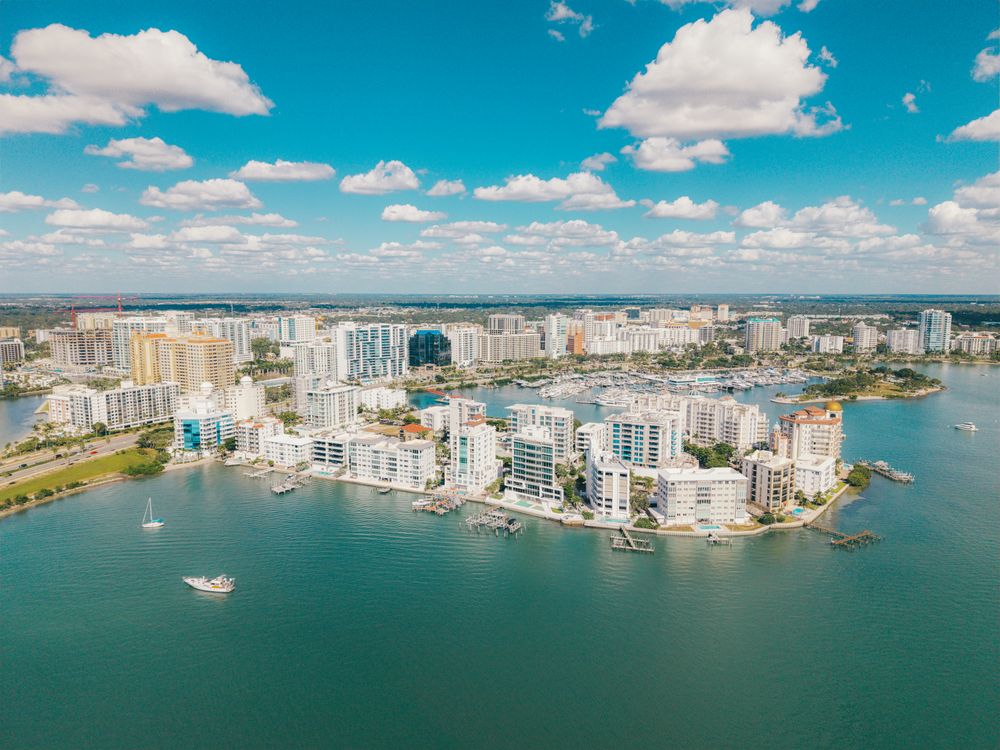
Every structure on that waterline has a denominator · Sarasota Bay · Photo: Stellar Media Collective
Questions builders actually ask
Who actually makes the determination? The local floodplain administrator in the community holding the permit — county or municipality, depending on where the parcel sits. FEMA writes the program rules; the community adopts and enforces the ordinance. Say that on camera, and then say it again.
A client wants to split the work across two years to stay under. What do I tell them? That the answer comes from the building department, not from you. Manatee measures cumulatively across a one-year period; Sarasota County treats phased permits on a single improvement as one calculation. Deliberately structuring work to dodge the threshold is not a service, and it is not something to put on video.
The tax value on the structure looks far too low. Is the client stuck with it? Generally no. Manatee and Charlotte both allow a qualified independent appraisal in place of the assessment, with conditions — Manatee wants a pre-storm effective date and photographs of pre-damage condition on storm claims. Whether a higher value helps depends on which side of the line the project sits, which is a conversation for before the appraisal is ordered.
Won't talking about this scare clients away? It filters them, which is different. The homeowner who walks after hearing it was going to walk at the permit counter anyway, with your pre-construction hours already spent. The one who stays has just watched you volunteer the hardest fact in the transaction.
Should a lawyer review the video? For a general explainer with no determination in it, a careful script and an on-screen line pointing viewers to their local floodplain office covers most of the exposure. If you plan to discuss a specific property, a specific determination, or insurance coverage, get it reviewed.
Rules and figures verified against FEMA and county floodplain sources as of August 15, 2026. Floodplain ordinances are adopted and amended locally and differ between Sarasota County, Manatee County, Charlotte County, and the municipalities inside them — confirm current requirements with the floodplain administrator for the jurisdiction holding the permit. This article describes how to communicate the rule accurately and is not legal, insurance, or floodplain-determination advice. Disclosure: this publication is owned by Stellar Media Collective, which produces video and content systems for Florida builders, including the kinds of explainer and estimate videos described above.