West of the Trail: The Teardown-Rebuild Wave and Who's Filming It
Sarasota's oldest premium neighborhoods are being replaced one lot at a time — ranches down, elevated houses up. The builders doing the work are largely invisible online, and the audience is standing on the sidewalk watching.
8 min read · August 11, 2026 · Florida Construction Media
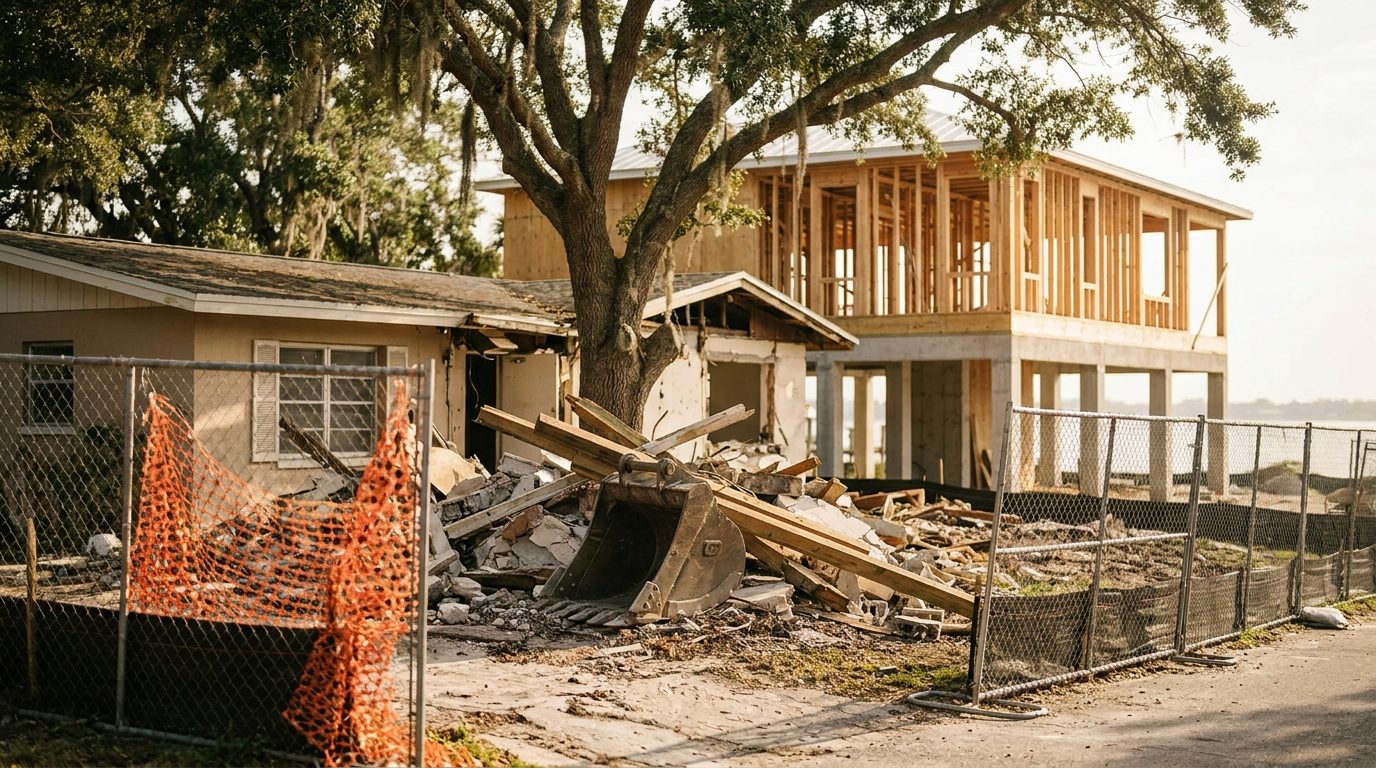
Drive south from downtown on Orange or Osprey, turn west toward the bay, and you can read the whole market off one block. A 1954 terrazzo-floored ranch with jalousie windows and a carport. Two doors down, an empty lot with the oaks fenced and flagged and nothing else on it. Across the street, a two-story house standing on concrete piers, framed and dried in, its finished floor a good four feet above where the neighbor's floor has sat for seventy years.
West of the Trail — the band of established neighborhoods between US 41 and the water, running from Hudson Bayou down through Cherokee Park, Harbor Acres, McClellan Park, and Oyster Bay — is not a growth corridor. Nothing is being added. It is being replaced, one lot at a time, and the replacement is running faster now than at any point since the last building boom.
The trades doing that work are, with a handful of exceptions, invisible. Search for a builder who does teardown-rebuilds in 34239 and you get real-estate listing pages, a few architect portfolios, and not much from the people holding the permits.
Three engines, not one
The wave gets described as a luxury story. It is really three pressures arriving on the same streets at once.
The dirt outgrew the house. In the closest-in blocks, the lot carries nearly all the value and the structure carries almost none. Once a serviceable house is worth less than the cost of bringing it up to what a buyer at that price expects, the arithmetic stops being sentimental. It is the oldest of the three engines, running since the mid-2010s.
The flood rules made the decision for a lot of people. Under the National Flood Insurance Program's substantial-improvement and substantial-damage provisions — the "50% rule," which Sarasota County explains in its own published FAQ — once repairs or improvements to a non-conforming structure reach half the structure's market value, the building has to come into compliance with current flood standards or come down. Helene and Milton pushed thousands of Gulf Coast houses over that line in a single season. The permit traffic that followed was visible from a mile away: Your Observer reported in April 2025 that Sarasota County had processed more than 6,000 storm-related permits since Hurricane Debby, that the City of Sarasota had taken 743 storm-related applications, and that Longboat Key logged 1,057 permit applications in a single March — roughly double the prior year, with twelve new full-time staff hired to keep up.
The mechanism is not unique to here. WLRN reported in October 2025 that Pinellas County issued about 250 demolition permits in unincorporated areas over a comparable stretch, roughly four times the year before, and that a single elevation quote can run past $100,000 — the number that turns a repair conversation into a teardown conversation at a lot of kitchen tables.
Insurance and hardening rewrote the spec. A new house here is not just newer. It is elevated, impact-rated, and built to a code cycle that prices differently — and clients now understand that in dollars, because their premiums taught them.
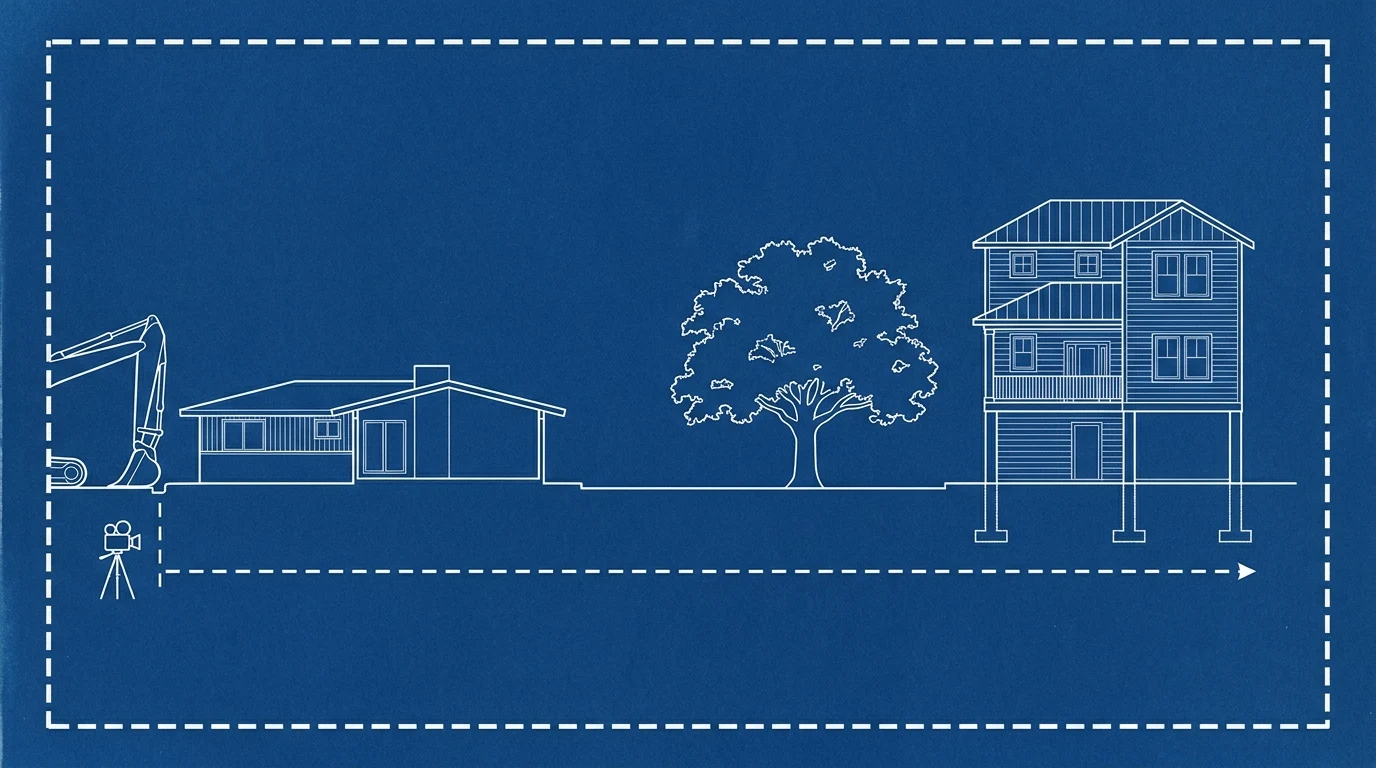
One street, three states — and a datum line running through all of it · Illustration: Florida Construction Media
This client shops nothing like a corridor buyer
A homeowner in a new master-planned community has no local network and asks a search engine. West of the Trail is the opposite condition: the buyer is embedded, often already lives within a mile of the lot, and asks three people before they ask the internet — an architect, a realtor who specializes in these streets, and a neighbor who just finished a build and has opinions about every week of it.
That changes what marketing has to do. You are not winning a cold search. You are trying to be the name that survives all three of those conversations intact, and then to hold up when the buyer goes home and looks you up anyway — which they do, every time, after the referral. Stellar's guide to the referral who looked you up covers that gap, and this is where it costs the most.
It also means the architect is a channel, not a competitor. A meaningful share of the work here is specified before a builder is chosen, and the firms that get shortlisted are the ones an architect can show a client without hedging.
The parts nobody films are the parts that decide it
Go look at what's published about these projects and it is almost entirely the finished house: a twilight exterior, a white kitchen, a pool. Beautiful, interchangeable, and useless to a homeowner who has not yet decided whether to tear down at all. The unfilmed middle is where the decisions live.
The teardown decision itself. Renovate or replace is the single biggest question a West of Trail owner faces, it usually turns on the 50% math, and almost nobody explains it on camera in plain language. Whoever does becomes the person that homeowner calls — a year before there is a job.
Demolition day. The most watched hour on the street, and the most misunderstood. Tree protection, asbestos survey on pre-1980 structures, utility disconnects, debris control, what neighbors should expect and for how long.
Elevation. Piers, stem walls, fill, the finished-floor number and where it came from, what it does to the driveway and the way the house meets the sidewalk. It is new to most owners, and it is the part they are quietly anxious about.
The oaks. Grand-tree rules, root zones, what can and cannot be removed, and how a crew builds around a canopy. On these blocks the trees are the neighborhood's identity, and a builder who visibly protects them buys goodwill that money cannot.
The design-review reality. Setbacks, height, lot coverage, what fits a street of one-story houses. Sarasota also has real architectural history here — the mid-century work that made the city's name — and the tension between replacement and preservation is locally felt and not something to be glib about on camera.
Spec box: the West of Trail rotation. One filmed half-day a month covers it. The decision film: renovate versus rebuild, the 50% rule in plain language, dated and sourced. Demo day: one honest sequence, start to cleared lot, narrated by whoever ran it. The elevation explainer: what the finished-floor number means for how the house looks and lives. The tree film: protection zones and what your crew does differently. The neighbor brief: hours, dust, parking, the trades' street etiquette — published, not just promised. The finished walkthrough: last, and shorter than you think. Publish each to a page that can actually rank — the text-plus-video architecture — rather than dropping them all into one portfolio grid.
None of this needs a crew or a cinematic budget. It needs a plan for what gets captured while you are on site anyway — the batch filming day discipline applied to a job already running fourteen months.
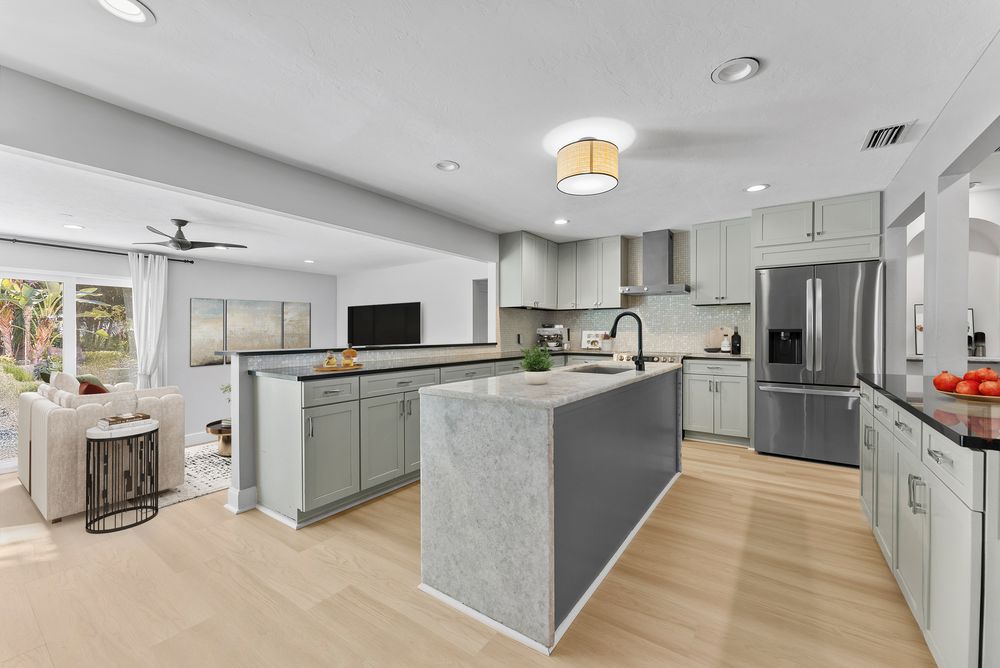
The end of a two-year conversation the neighbors watched all the way through · S Orange Ave, Sarasota · Photo: Stellar Media Collective
The street is the audience
The people watching your job site are the people who will hire you next. They walk past it daily. They have a house of the same vintage, on the same flood map, with the same decision ahead of them, and they are forming a judgment about you from the sidewalk over eighteen months — from how the site looks on a Friday afternoon, how the crew parks, whether the dumpster is where it said it would be.
Content does not replace that. It compounds it. The neighbor who has already decided you run a tidy site, and then finds a clear explanation of the elevation question with your name on it, has effectively hired you before the call. That is the ordinary version of the 97% who are not buying yet — except here they are not an abstraction, they are four houses away.
And the clock matters. These neighborhoods have a finite number of teardown-ready lots. Every one that goes is gone for forty years. The builders who are documented on these streets now are the ones who get named when the next block turns.
Questions builders actually ask
Our clients are private. Can we even publish these projects? Some of them, with permission — and less than you would think. Decision content, demo sequences, elevation explainers, and tree-protection work carry no identifying detail at all: no address, no owner, no interior. Get written permission for anything filmed inside or identifying a home, and keep a release in the contract so the question is settled at signing rather than at the reveal. The keys have the same problem, and the same answer.
Isn't the finished-house film the one that sells? It is the one that closes an already-warm client, and you should have it. It is not the one that creates clients, because a homeowner who has not decided to build cannot use it. Sequence it last and keep it short.
How careful do we have to be talking about the 50% rule? Very. It is a real regulatory threshold, administered locally, and the details differ between the City of Sarasota, the county, and each barrier-island town. Explain the mechanism, date the video, say plainly that the determination is the jurisdiction's to make, and point people to their building department. Being useful and clearly bounded reads as authority. Being wrong in public reads as the contractor problem homeowners already fear.
We're a small custom shop with one job running. Where do we start? The job you are on. One page for it, one film of the decision behind it, one demo sequence. That is a month of work that outlives the project by years. Stellar's custom-home-builder page, Sarasota area page, and resource library cover the mechanics.
Figures checked against published sources as of August 11, 2026 — Sarasota County's published substantial-improvement FAQ, Your Observer's April 2025 reporting on regional post-storm permitting, and WLRN's October 2025 reporting on Florida flood-resistance rules, whose demolition-permit and elevation-cost figures are from Pinellas County and are cited here as an illustration of a rule that applies in Sarasota, not as Sarasota data. Floodplain determinations, permit rules, and tree ordinances vary by jurisdiction and change; confirm current requirements with the City of Sarasota or Sarasota County before repeating any of it in your own marketing. Florida Construction Media is published by Stellar Media Collective, a video and marketing studio serving Gulf Coast contractors.