The Handoff Film: A Closing-Day Video Clients Actually Share
The last twenty minutes of an eighteen-month relationship are the most shareable footage a builder will ever have, and almost nobody rolls on them. The shot list, the permissions, and the three cuts that come out of one afternoon.
8 min read · August 17, 2026 · Florida Construction Media
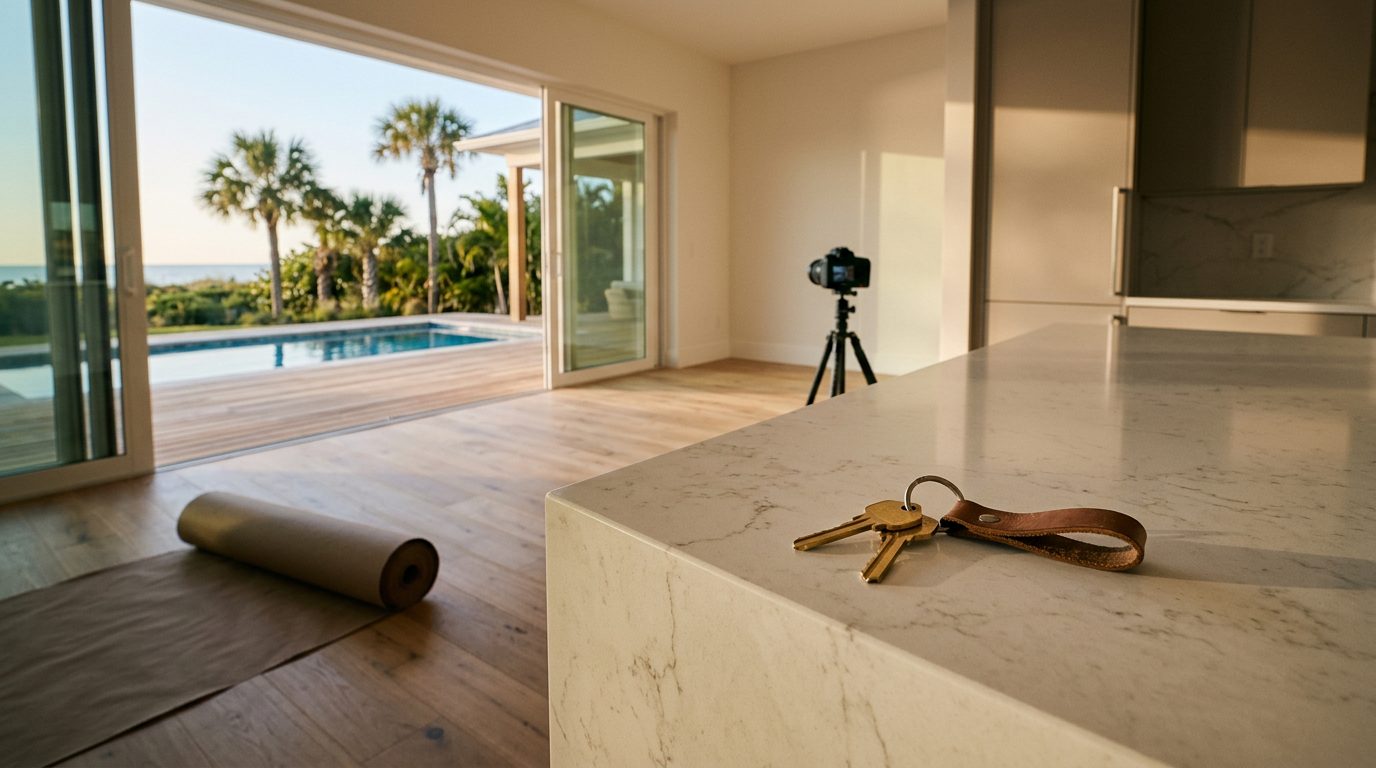
The punch list closed on Thursday. The cleaners came Friday. On Monday morning a project manager hands over a labeled key ring and a binder of manuals in a kitchen that still smells like new cabinetry, the owners take a picture of each other on their own phones, everybody shakes hands, and the truck rolls to the next job by ten.
That is the end of an eighteen-month relationship. For most builders it is also the only part of that relationship with no footage. There are 400 progress photos of the slab, the trusses, and the tile layout, a drone pass from the week the roof went on, and nothing at all from the twenty minutes that the client will remember for the rest of the time they own the house.
The handoff film fixes that, and it is the cheapest piece of content in this entire publication to produce: one afternoon, one camera, a microphone, and a decision made three months earlier.
The one film your client distributes for you
Every other piece of marketing you make has to buy or earn its way in front of people. You run it as an ad, you post it and hope the platform agrees, you email it to a list that opens at some rate. The handoff film is different in one specific way: the people in it send it to their own contacts, unprompted, because it is about them.
That matters because of when it happens. Goodwill is perishable. Eleven months into the warranty period, after the third callback about a sticking door, a client's feelings about you are complicated and fair. On the day they get keys, they are as close to pure advocacy as they will ever be, and that is the window most builders spend driving to the next site.
This is also where the referral leak lives. Somebody at a dinner party says they're thinking about building. Your former client says you should call the guy who did our house, and then nothing happens, because there is nothing to hand over. A ninety-second film with their own faces in it is something to hand over. Stellar's guide on the referral who looked you up covers what that warm lead does next; the handoff film is what they arrive already having watched.
The market case is unglamorous. NAHB's February 2026 forecast has residential remodeling activity rising 3% in 2026 and 2% in 2027 in inflation-adjusted terms. Single-digit growth is a market where the yield you get from each finished job (referrals, repeat work, proof for the next prospect) moves your year more than another notch of ad spend.
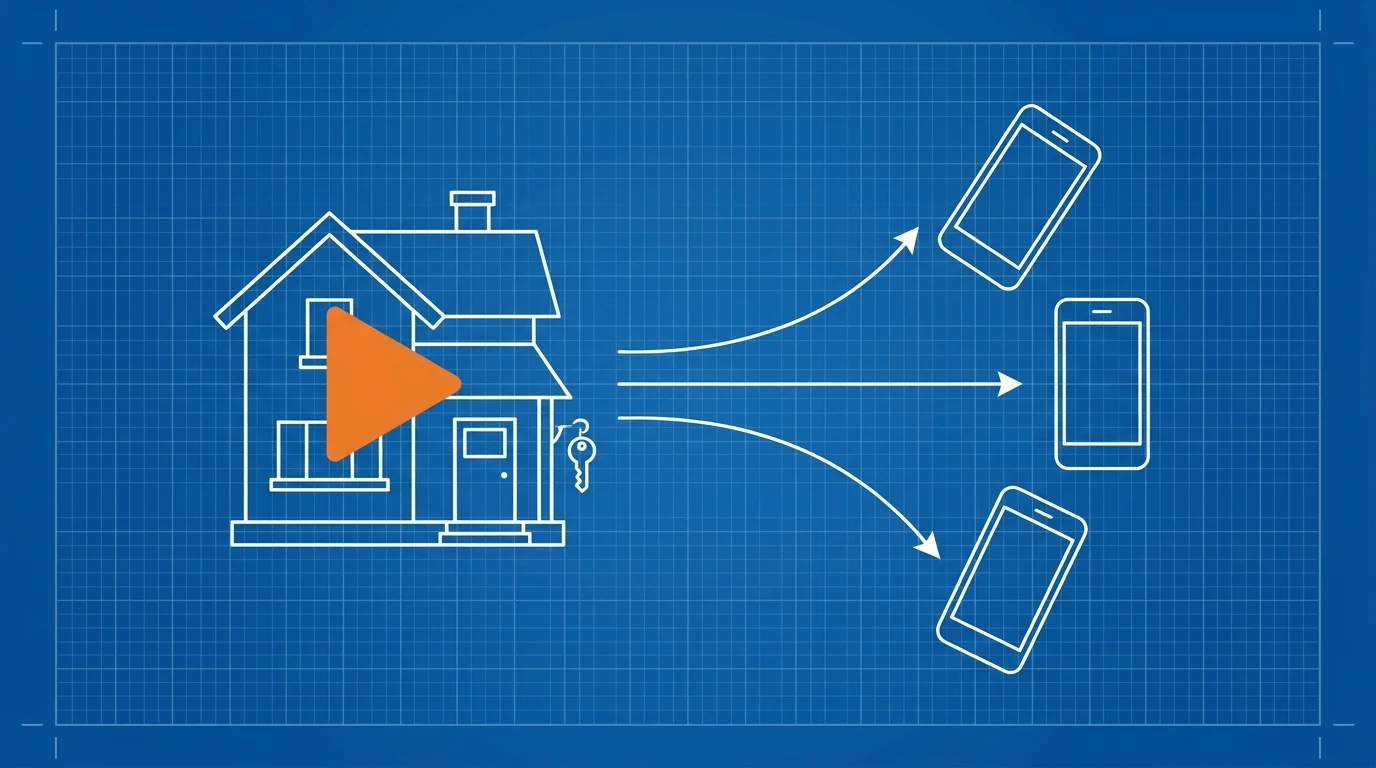
One afternoon of footage, distributed by the only people who can · Illustration: Florida Construction Media
What actually goes in it
The failure mode here is a company video wearing a client's clothes: your logo, your drone footage, your superintendent explaining the mechanical room, and thirty seconds of the owners standing there being thanked. Nobody forwards that. The test for every shot is whether the client would send it to their sister.
The handoff film, speced: 90 seconds to 3 minutes finished. One camera, one lavalier microphone on the owner, one afternoon on site (45 minutes of filming, tops). Shot list: the exterior approach in good light; the owners' first walk through the finished space, unstaged; one cutaway to a before frame or a rough-in still; the crew who built it, named; 20 to 40 seconds of the owner talking, unscripted; the keys changing hands; a closing frame with the company name and nothing else. No hard call to action. No sales copy. The film is a gift, and the marketing value is a consequence of it being a good one.
A few of those deserve expanding.
The walk is theirs, not yours. Let the owner lead and react. The line you want is not an endorsement of your company. It is a woman stopping at a window and saying that's the light she was talking about for a year. Your superintendent narrating cabinet reveals is a different, less useful film.
Name the crew. The framing lead, the tile setter, the finish carpenter, by name, on camera or in the edit. Two audiences care: the client, who wants to know who built the thing they will live in, and the trades themselves, who send it to their families. It is the same footage that carries a recruiting video later.
Use one before frame. Not a montage. If you ran a time-lapse rig on the job, a single hard cut from bare lot to finished room does more than four minutes of process footage. The client already lived through the process. The contrast is for everyone else.
Do not close on a pitch. A card with your company name is enough. The person who watches this and calls you does so because it made them feel something about their own half-built plan, not because a lower third told them to book a consultation.
Filming a day you only get once
There is no reshoot. That fact drives every logistics decision.
Ask at contract, not at the door. The permission conversation belongs in the pre-construction meeting, alongside the schedule and the selections calendar: at the end, we film the handoff, we give you the film, and we would like to use a version of it in our marketing with your approval. Getting a signed release eighteen months early costs nothing. Asking a homeowner to sign one while their kids are running through the house is a bad look, and gets you a nervous performance even when they say yes.
Put it on the schedule as a task. The handoff film dies when it depends on someone remembering. It belongs in your closeout checklist between final clean and warranty orientation, with an owner assigned, the same way the punch walk does.
Protect the light and the sound. Late afternoon for anything with west-facing glass, which in this market is most of the good rooms. A lav on the owner: a camera microphone in a hard-surfaced, unfurnished house records reverb, and reverb reads as amateur even to people who could not name what is wrong.
Film the house first, the people second. Get your empty-room and exterior coverage before the owners arrive. It keeps the human part short, which keeps it real. Forty-five minutes of standing around is how you get a family that looks like it is enduring a photo shoot.
When the answer is no, take the house. Privacy-minded clients are common in the coastal high end, and some second-home owners will decline anything with their faces in it. Film the finished house and the crew, deliver the film to them privately as a record, and keep the marketing version off the internet. The relationship is worth more than the asset, and the testimonial system gives you other roads to the same proof.

Twenty minutes at the end of eighteen months · Venice · Photo: Stellar Media Collective
Three cuts out of one afternoon
The gift cut, 90 seconds. Theirs. Delivered as a file and a private link within a week, while it still feels like part of the event. Vertical or square, because the way it travels is a text message. This is the only cut with a deadline that matters.
The archive cut, 4 to 6 minutes. The long walk, the crew, the before-and-after, the owner's full interview. Private link, no promotion. Clients who build once in their lives keep these, and adult children of aging-in-place clients watch them more than you would guess.
The marketing cut, 60 to 90 seconds. Approved separately, in writing, after the client has seen it. Structurally this is act three of the three-act project story: everything you have already published about the build was setup, and this is the payoff. It also does honest work on a project page or in a proposal, because it shows the end state of the process a prospect is being asked to buy.
One framing worth keeping through all three: the client is the hero of this story and your company is the guide who got them there. It's the vocabulary StoryBrand gave the marketing world, and closing day is the only day of the job where the casting is obvious on camera. You are holding the keys. They are taking them.
Questions builders actually ask
Isn't this just a testimonial video? No, and the difference is why it works. A testimonial is an interview about you, filmed to be published. A handoff film is a record of their day, filmed to be given away. Watch what people forward and the distinction stops being academic.
What if the client is stiff on camera? Most are, for about four minutes. Film the walk before the questions, keep the crew small, and never hand them a script. If a client freezes anyway, the film survives on the house, the crew, and the keys. The owner's voice is the best ingredient, not a required one.
Can my PM shoot it on a phone? For the gift cut, yes, with a clip-on microphone and someone who understands not to shoot into windows. For the marketing cut on a project worth six or seven figures, the quality of the film is read as a proxy for the quality of the work, the same way it is on every other flagship piece.
We build production homes, not customs. Does this scale? It scales differently. Filming every closing is not realistic; filming one a month is, and a rotating library of real handoffs beats a single polished brand film that gets old. Community and model-home marketing lives on exactly this footage.
How soon can I use it? Gift cut inside a week. Marketing cut after written approval, and it is worth waiting for. A client who approves the film at day thirty is also the client who takes your call at month eleven, when you are asking for the anniversary follow-up that keeps the long tail of the relationship alive.
Market figures verified against NAHB's February 18, 2026 remodeling forecast as of August 17, 2026. Release forms and client-approval practices vary; have your own agreement reviewed before publishing footage of a client's home. Disclosure: this publication is owned by Stellar Media Collective, which produces video and content systems for Florida builders, including the handoff and project films described above.