The Pre-Frame: How Video Before the First Call Changes the Whole Sales Conversation
By the time a homeowner books a call, they have already searched you, read your reviews, and half-decided. A short video sent before that call turns it from an audition into a confirmation.
7 min read · July 13, 2026 · Florida Construction Media

Most builders treat the first call as the beginning. It isn't. It's the middle.
By the time a homeowner picks up the phone or fills out your form, they have already searched your company name, read your reviews, looked at your project photos, and lined you up against a competitor or two. A 2026 analysis of homeowner behavior from improveit360 put it plainly: "by the time a lead reaches your CRM, that homeowner may have already searched your company name, read your reviews, compared you to a competitor, and formed a first impression." The same research found roughly 70% of homeowners now compare only two or three quotes — a shorter list, with much higher standards for making it onto that list at all.
So the call is not where they decide whether to trust you. That happened earlier, quietly, without you in the room. The question worth asking is what you put in that room in your place. For most builders, the answer is nothing — a website, some photos, a star rating. The pre-frame is the practice of putting a short, deliberate video there instead, so the homeowner walks into the first conversation already knowing who you are and how you work.
The call isn't the beginning
There's a term for this in sales that's worth borrowing exactly once: the pre-frame. It means setting the frame a person uses to interpret you before they meet you, so they arrive reading the encounter the way you'd want them to. Salespeople do it with a well-timed email. You can do it far better with a two-minute video, because a homeowner deciding whether to hand you a $300,000 remodel is not evaluating your argument. They're evaluating you — your steadiness, your judgment, whether you'll disappear when the tile shipment is late. None of that survives a paragraph of website copy. All of it comes across in ninety seconds of you talking on a job site.
Consider what the alternative asks of the client. Without a pre-frame, the first call is a cold audition. The homeowner is nervous, guarded, comparing you in real time to a firm they talked to yesterday, and half the conversation is spent establishing basic credibility that a video would have settled before you dialed. With a pre-frame, they've already watched you explain how you handle a change order. They've seen your face, heard your voice, decided you seem like someone who tells the truth. The call starts thirty minutes ahead of where it used to.
This matters most in a market where trust is the scarce resource. A 2024 Leaf Home survey conducted with Morning Consult, covering 2,074 homeowners, found nearly 70% worry about unreliable contractors and 41% say they've been deceived by a service provider. Your prospect is not arriving optimistic. They're arriving braced for disappointment, and the builder who shows up as a known, steady quantity before the meeting is the one who gets the benefit of the doubt.
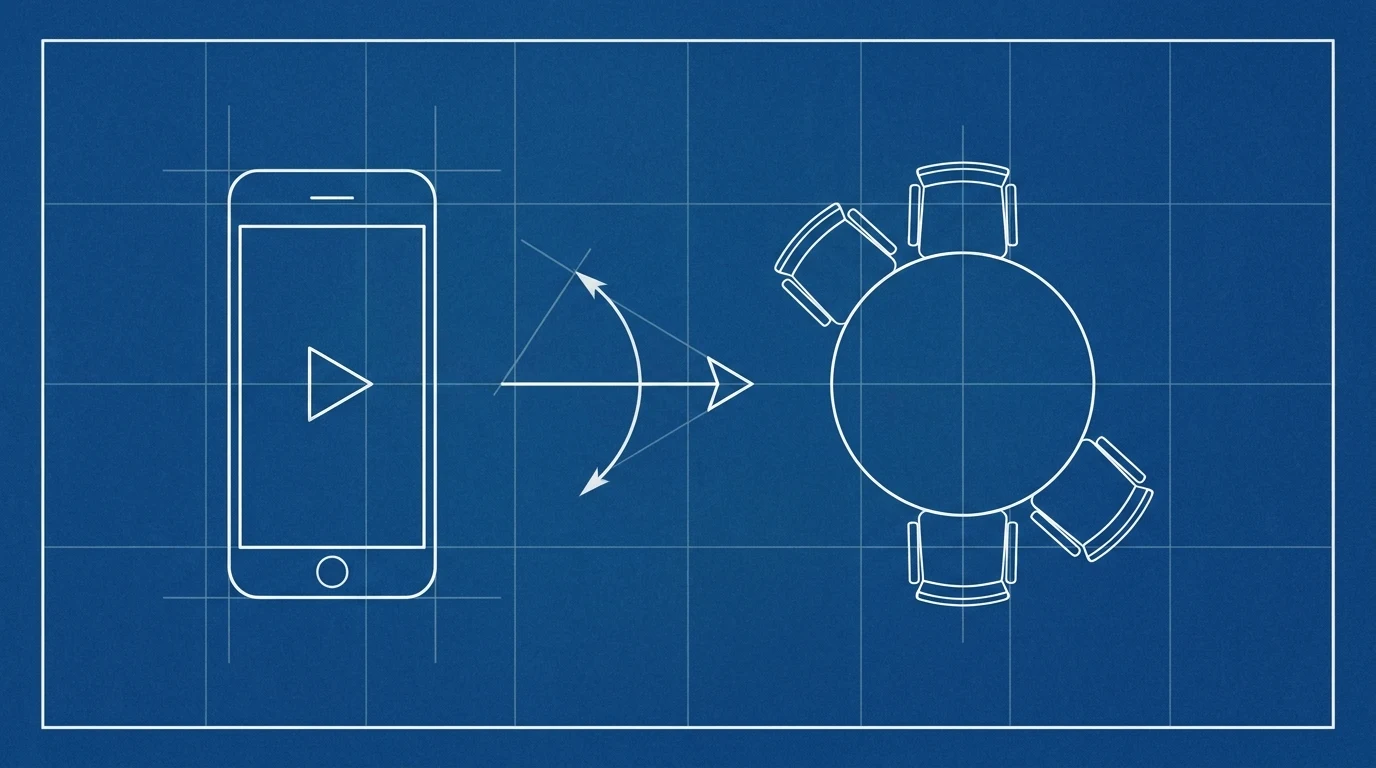
A video watched before the meeting reframes the meeting itself · Illustration: Florida Construction Media
The three videos that do the work
A pre-frame isn't one video. It's a small kit of short pieces, each aimed at a specific moment before the call. You film them once and send them for years.
1. The owner introduction — who you are, in ninety seconds. You, on camera, on a real site, saying who you are, how long you've built in this county, and the one thing you refuse to compromise on. This is the video that makes you a person instead of a logo. It's the single highest-leverage piece a builder can own, because it does the work that positioning copy pretends to do. If the idea of being on camera makes you wince, the fix is a script and a few takes, not a personality transplant — we broke the format down in owner-on-camera scripts.
2. The process walkthrough — how the job actually goes. Three to four minutes explaining your named steps: what happens after they sign, who they'll talk to, how you handle the surprise behind the wall. A homeowner's deepest fear isn't the price; it's the chaos — the dust, the delays, the not-knowing. A calm walkthrough of your process pre-answers it. This is the same reason "call for a free quote" loses to a named, three-step plan: a nervous stranger can say yes to a process they can see, not to an open-ended sales visit.
3. The proof piece — a real client, in their finished home. Not a testimonial reel of adjectives. One past client standing in the kitchen you built, describing how the budget held and what they were afraid of before they hired you. This is the piece that makes the claim land, because a homeowner saying it is worth more than any promise you make about yourself. Getting that footage without making the client uncomfortable is its own skill; the testimonial system covers how.
Notice the sequence: who you are, how you work, proof it works. It's the same order a cautious buyer checks things in their head. You're just answering in the order they ask.
Rule of thumb: if a prospect could watch your pre-frame kit and still not know your name, your process, and one real client's outcome, it isn't a pre-frame — it's a highlight reel. The test is specificity. A pre-frame answers "what happens if I hire this person," not "is this person good at video."
Where the video actually goes
A pre-frame only works if it lands before the call, which means it lives in your booking flow, not your website's video gallery where nobody scrolls.
The three placements that matter: the reply to an inquiry (a homeowner fills out your form and the auto-reply includes the owner intro, so the first thing they get back is your face, not a calendar link), the booking confirmation (the process walkthrough goes in the "you're confirmed for Thursday" email, so they arrive having seen how the job runs), and the proposal itself (the proof piece rides along with the estimate, because your best proposal often gets forwarded to a spouse or decision-maker who never met you — a problem the proposal video exists to solve). The through-line is placement over polish: a phone-shot video in the right email beats a cinematic one buried on a page nobody opens.
This is also why the pre-frame quietly fixes your follow-up. When a lead goes cold, you're not chasing with "just checking in." You're sending the next useful video — and the follow-up machine has real material to send instead of nagging. The pre-frame kit and the nurture sequence are the same assets pointed at two different moments.
A first impression forms before anyone calls · Venice Downtown · Photo: Stellar Media Collective
Questions builders actually ask
Isn't this just marketing that happens to be on video? The difference is timing and intent. A marketing video tries to generate a lead. A pre-frame assumes the lead already exists and is deciding, and it's engineered to reach them in the specific gap between "I found them" and "we talked." Same camera, different job. Most builders film for the top of the funnel and leave the bottom — the highest-intent moment they have — completely silent.
How long should these be? Short. The owner intro runs about ninety seconds, the process walkthrough three to four minutes, the proof piece under three. A homeowner about to spend six figures will watch a few minutes of the right video attentively. They will not watch a fifteen-minute company anthem, and asking them to is how you lose the momentum you built.
We already have a testimonials page. Isn't that enough? A page they might find is not the same as a video they receive at the moment of decision. Reviews and testimonials matter — the majority of homeowners read them before they'll even consider you — but they're passive. The pre-frame is deliberate: you choose which proof reaches them and when. Owned placement beats hoping they scroll.
What does a builder actually need to start? Three videos and the discipline to put them in three emails. The owner intro is the one to film first; it's the piece that does the most and the one nobody else in your market has bothered to make. This is content for the buyers who aren't ready to sign yet and the ones about to — which is what makes it the most efficient footage a builder can own.
Published July 13, 2026. Homeowner-behavior and trust figures are drawn from the 2026 improveit360 analysis and the 2024 Leaf Home/Morning Consult survey linked inline, and will drift over time; no statistics here are our own. Disclosure: this publication is owned by Stellar Media Collective, a Sarasota studio that builds pre-frame video kits for builders and premium trades — more on the approach in our resources guides. The system works whether you film it yourself or hire anyone to help.