The 14-Month Documentary: A Filming System for Custom Home Builders
A custom home takes longer to build than most marketing campaigns run. Filmed on a schedule instead of on impulse, that year yields one flagship film, a handful of chapters, and a year of short pieces, all from nine half-days on a site you were already driving to.
9 min read · August 21, 2026 · Florida Construction Media
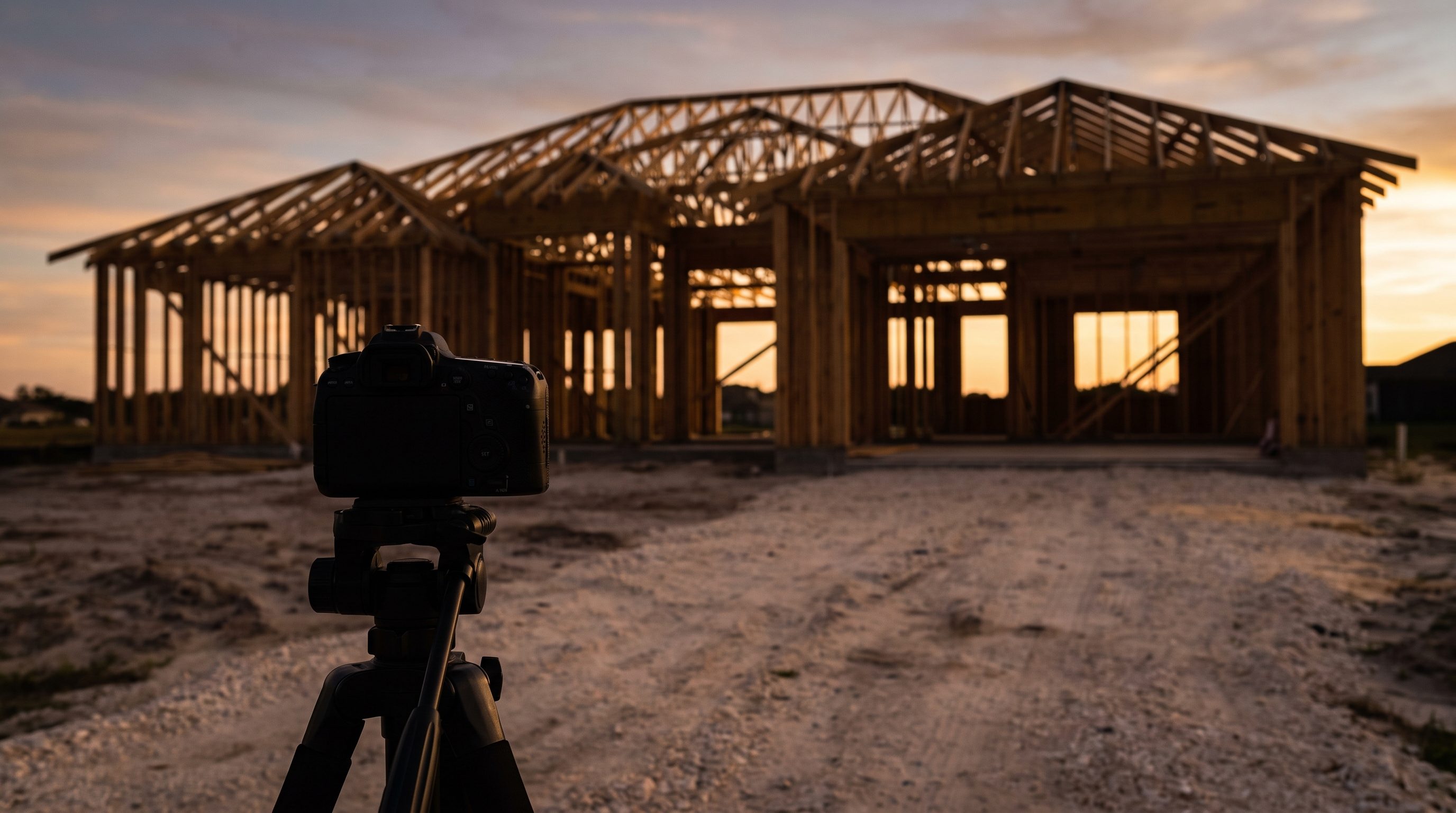
Almost every custom builder on this coast has the same footage. A drone lap of the lot from the week the trees came down, forty seconds of trusses swinging on framing day because somebody happened to be standing there with a phone, then a gap of nine or ten months, then a gallery of finished photographs shot the week before closing.
Two moments and an ending. The part in between, the part the next client is actually anxious about, went unrecorded, on a job site the builder visited two hundred times.
That is a scheduling problem, not a discipline problem. Nobody films a fourteen-month project because nobody has fourteen months of attention. What works is treating the camera the way you treat an inspection: a handful of fixed, calendared visits tied to milestones you already have to be on site for.
The build is longer than most marketing campaigns
Start with the timeline, because the timeline is the whole opportunity.
The Census Bureau's Survey of Construction, summarized by NAHB in September 2025, put 2024 single-family construction at an average 9.1 months from start to completion. But that average is carried by production housing: homes built for sale averaged 7.6 months from permit to completion, while contractor-built homes (the custom category) ran about 12 months and owner-built homes 15.1.
In practice, a Gulf Coast custom in the $1.5M-and-up band runs longer than that national figure once design, permitting, and selections are counted from the day the client signs. Fourteen months is a fair working number for this market; your own last three jobs are a better one. Either way it is more than a year of continuous, visible, expensive activity happening on a property you control.
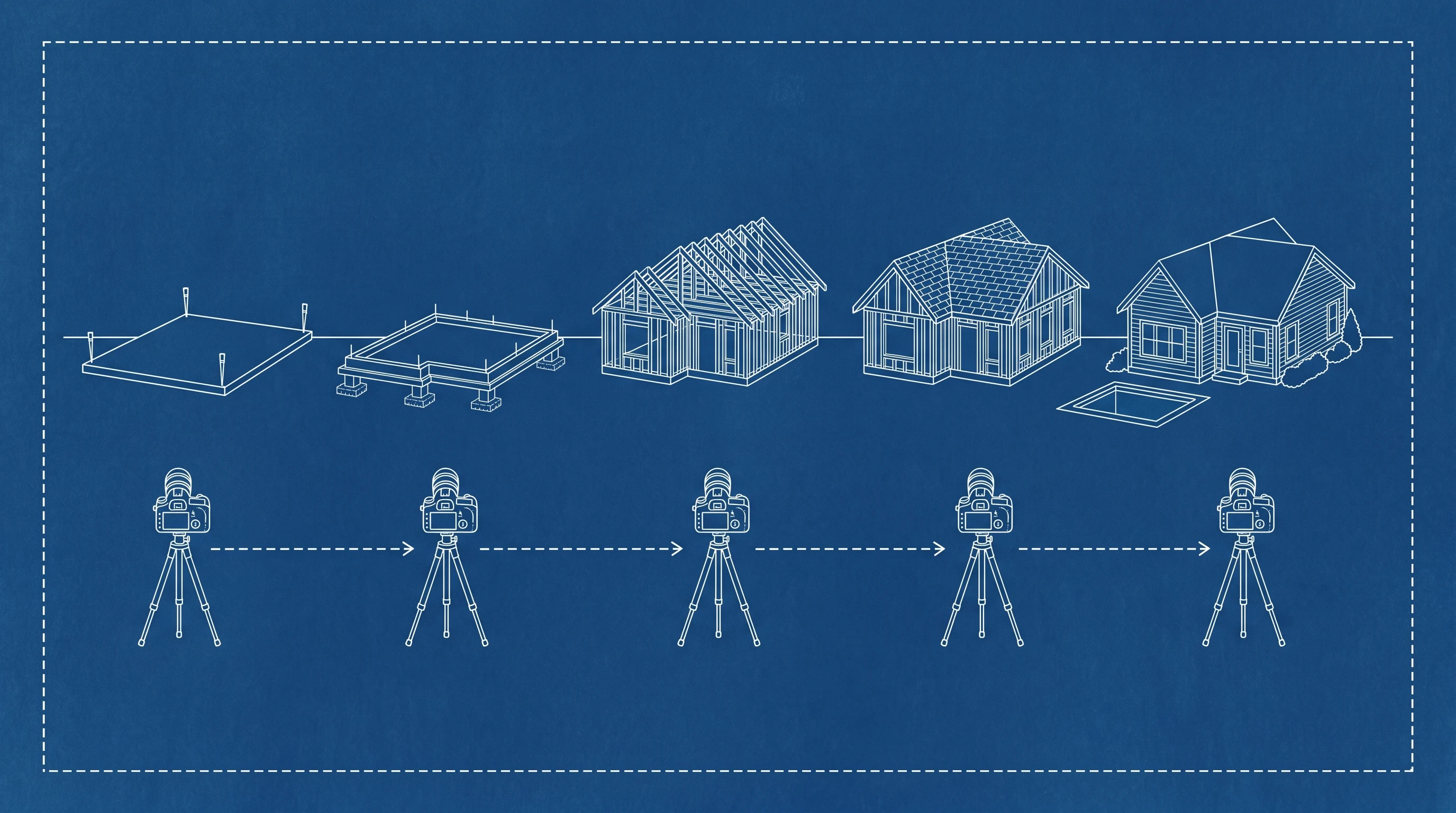
Nine calendared visits, not fourteen months of filming · Illustration: Florida Construction Media
The second reason to care is that this segment is holding while the rest of the market is not. NAHB reported on August 19, 2026 that custom single-family starts totaled 49,000 in the second quarter, down 9 percent from a strong Q2 2025, with the last four quarters at 183,000 against 184,000 in the prior four: effectively flat, and about 20 percent of all single-family starts on a one-year moving average. NAHB's read is that custom building is less sensitive to the rate cycle than the rest of homebuilding and more sensitive to household wealth. Flat volume means the same clients fought over by the same builders, and proof is the tiebreaker.
Nine visits, not fourteen months
The system is nine half-days, each pinned to a milestone that already exists in your schedule. Two hours each, one operator, no crew call.
- The lot, before anything. Raw ground, survey stakes, the clients walking it and saying out loud what they want. This is the only footage you can never go back and get, and it is the opening of every cut you will ever make from this project.
- The design table. Plan review, the architect or designer explaining one hard decision, the clients choosing between two options. The invisible half of design-build is the phase premium buyers most want to see and the phase almost nobody films.
- Ground breaking and foundation. Clearing, fill, pilings or stem wall, the pour. Loud, big, and legible to a layperson: the easiest day on the list to make look like something.
- Framing and dry-in. The day the house first has a shape. Get the drone lap here, but get the ground-level walk too; the aerial sells scale and the walk sells rooms.
- The walls-open day. Rough electrical, plumbing, mechanical, and every strap and connector a client will never see again. This is the highest-value visit in the sequence, because it is the day your work is visible and your competitor's is not.
- Envelope. Impact windows and doors set, roof on, stucco or siding. In Florida this is the hardening story homeowners ask about unprompted. The case for the year-round home-hardening angle applies just as well to new construction.
- Finishes. Cabinets and millwork set, tile, trim, the first day the house smells like a house. Craft footage lives here.
- Punch and pre-delivery. The list, the touch-ups, the superintendent doing the thing clients assume nobody does.
- Handoff. Keys, first walk through the finished rooms, the client's reaction while it is real. The closing-day handoff film and the testimonial interview both come out of this one afternoon.
A time-lapse rig runs underneath all nine, unattended, from the day the pad is cut. The interval math and mount hardware matter more than the camera does, and a Florida summer will find out whether you got them right.
What one build yields
Nine half-days is roughly 18 hours on site across a year. Here is the honest output, assuming somebody actually edits it.
One flagship documentary, 8 to 14 minutes. The whole build, structured as a story rather than a chronology: the family's problem, the plan, the hard parts, the house. This is the piece a $2M prospect watches to the end because they are about to do the same thing.
Five to eight chapter films, 3 to 5 minutes. Foundation, framing, the walls-open day, the envelope, finishes. Published as the build progresses, so the marketing is live for a year instead of arriving after the project is over.
Thirty to fifty verticals. One good ninety-second answer per visit, plus the moments: the pour, the truss set, the strap detail. This is where the 16:9-first discipline pays for itself, because verticals derived from properly shot footage cost nothing extra.
A time-lapse suite and a stills library. A sixty-second full-build compression, three or four stage cuts, and frames from every visit good enough for the website and the proposal.
Spec box: the nine-visit custom build. Nine half-days, each pinned to an existing milestone: raw lot, design table, foundation, framing/dry-in, walls-open, envelope, finishes, punch, handoff. One operator, two hours per visit. One time-lapse rig running unattended from pad to punch. Releases signed at contract, not chased at the end. One publish slot per month for the whole fourteen months, so the chapter films go out while the build is live. Deliverables: one 8–14 minute flagship, 5–8 chapter films, 30–50 verticals, a time-lapse suite, and a stills library. Budget the edit, not just the shoot. Roughly two-thirds of the cost of this system is post.
Who is actually watching
Three audiences, and they want different things from the same footage.
The client, mid-build. A family that signed in February and will not stand in their kitchen until the following spring spends most of that year with nothing to show anyone. A monthly chapter film is the cheapest thing you can do to keep a signed luxury client warm through the wait, and it quietly documents what was decided and when.
The next client. A custom prospect is not comparison-shopping a price; they are trying to find out whether fourteen months with your company will be tolerable. The flagship film on a proper project page built for search, plus the chapters on YouTube where the homework happens, answers that in a way a gallery cannot. It is the three-act project story at full length, with the middle act finally present.
Architects, designers, and your own bench. The people who send you work want to see execution, and the trades you want to keep want to see their work treated as craft. Stellar's custom home builder page and its resource library go further into how that proof gets assembled.
Where the series dies
No publish schedule. Filming without a calendar produces 400 gigabytes and nothing published. Decide the monthly slot before the first visit.
Waiting for the finish. Builders hold everything back for the big reveal, then publish fourteen months of marketing on one Tuesday. The chapters are the campaign; the flagship is the closing argument.
No release. Get filming permission into the contract, with the client holding veto power over the final cut and the right to keep the address off-screen. Asked at signing it is routine; asked at month eleven it is a negotiation.
Filming everything. The failure mode of ambitious builders is over-capture. Nine visits is the system; a tenth with no plan attached is just more footage nobody will watch.
Nobody owning it. Your superintendent will not become a videographer, and asking them to is how the system stops in month three. Name the person, or hire the visit.
The house at the end of nine visits · Venice · Photo: Stellar Media Collective
Questions builders actually ask
What if the job goes sideways: a delay, a change order fight, a subcontractor problem? Then you have a decision, not a crisis. The client holds veto power over the final cut, so nothing airs they object to. In practice the difficult projects produce the most persuasive footage, because handling a problem on camera is the proof premium buyers are hunting for. What you never do is manufacture a problem or narrate a dispute you are still in.
Can our superintendent shoot this on a phone? Some of it, well. The walls-open day and the finishes day benefit from a phone in the hands of the person who knows what matters. Those are explanation pieces, and rough reads as real. The lot, the handoff, and the flagship edit are different work. The common failure is not phone footage; it is that the super has a job, and the ninth visit lands during a bad week every single time.
Our clients are private. Some are behind gates, one signed an NDA. Then film craft, not address. Interior details, materials, the strap detail, the millwork, cut without exteriors, street views, or anything identifying. An anonymized build still carries the process story, which is the part that sells. And ask anyway: plenty of clients who will not do an on-camera interview are glad to have the house filmed.
We only start two or three customs a year. Is one build enough? One build filmed properly outperforms four filmed incidentally. Two a year at this cadence puts a new chapter film in front of your market every month, and after three years you have a library no local competitor can assemble retroactively: they would have had to start filming three years ago.
Figures checked against published sources as of August 21, 2026: the Census Bureau's Survey of Construction data on 2024 single-family construction timelines as summarized by NAHB's Eye On Housing in September 2025, and NAHB's custom home building report published August 19, 2026. The fourteen-month figure in the title is a working assumption for premium Gulf Coast coastal customs, not a published statistic. The national contractor-built average was closer to twelve months in 2024, and your own completed projects are the better benchmark. Florida Construction Media is published by Stellar Media Collective, a video and marketing studio serving Gulf Coast contractors; the system described here is the kind of work it sells, and the schedule stands regardless of who films it.